

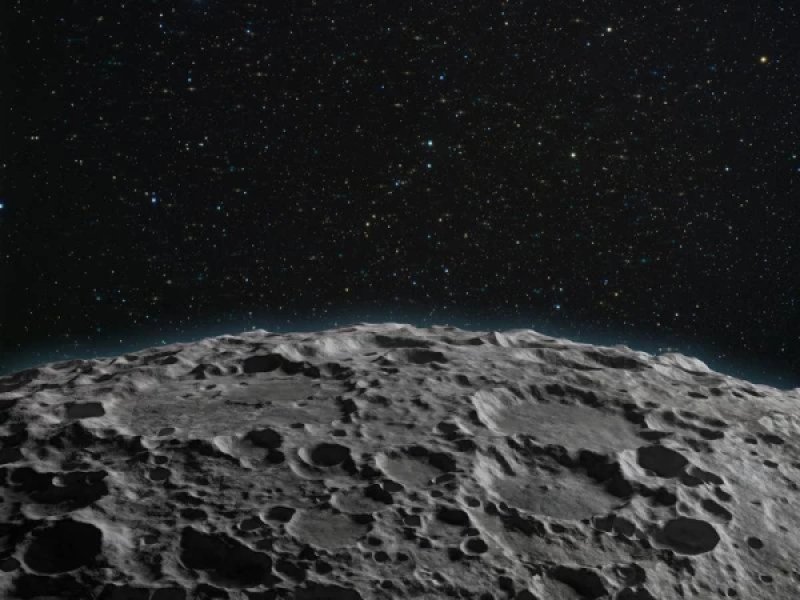
The discovery of ice in permanently shadowed craters at the poles of the Moon has sparked plans to create scientific bases first, and then full-fledged cities. However, a new study published in the journal Frontiers in Space Technologies questions the feasibility of large settlements on the Moon. Scientists attempted to assess how long lunar cities with populations of 100,000 and 1 million people could exist if they utilize the known water reserves and modern water recycling technologies. The researchers note that there should not be significant issues with energy supply. At the edges of polar craters, there are areas that are almost constantly illuminated by the Sun. These are sometimes referred to as "peaks of eternal light." Large solar power plants with capacities of up to 3 gigawatts could be placed here, and in the future, even the production of solar panels from local silicon could be established. This opens up possibilities not only for scientific stations but also for industry. In particular, the authors of the study suggest that energy-intensive data processing centers for artificial intelligence could emerge near such solar sites. The main problem remains water. According to the most optimistic estimates, there may be about 1 billion tons of water ice in the polar craters of the Moon. Even if purification systems can recycle 98% of the water — approximately the level currently achieved on the International Space Station — a city of a million could only exist for just over 100 years before the reserves are depleted. At the same time, many experts believe that the actual amount of water is significantly less. Some modern estimates are about 30 times lower than the most optimistic scenario. In that case, even a relatively small city risks facing water shortages in about ten years. Meanwhile, small settlements appear much more realistic. According to the scientists' calculations, a lunar village of about 1,000 residents or a small town with a population of around 10,000 could exist for several centuries if water is effectively recycled. The researchers propose several possible solutions. Among them are further increasing the efficiency of water purification systems, reducing water consumption through new technologies such as vertical farming, transporting water from asteroids, and searching for new ice deposits directly on the Moon. The authors consider the latter option to be the most promising. Modern instruments can only explore a few meters below the surface, while the layer of lunar regolith in polar regions can reach dozens of meters and hide additional ice deposits. Today, many lunar exploration projects — from research bases to Jeff Bezos's ideas about relocating industry and Elon Musk's plans for building "self-growing cities" — largely depend on the answer to one question: will it be possible to find significantly more water on the Earth's satellite than is currently known? The conclusion of the study is simple: the main resource for future lunar cities will not be energy, but rather water.
