

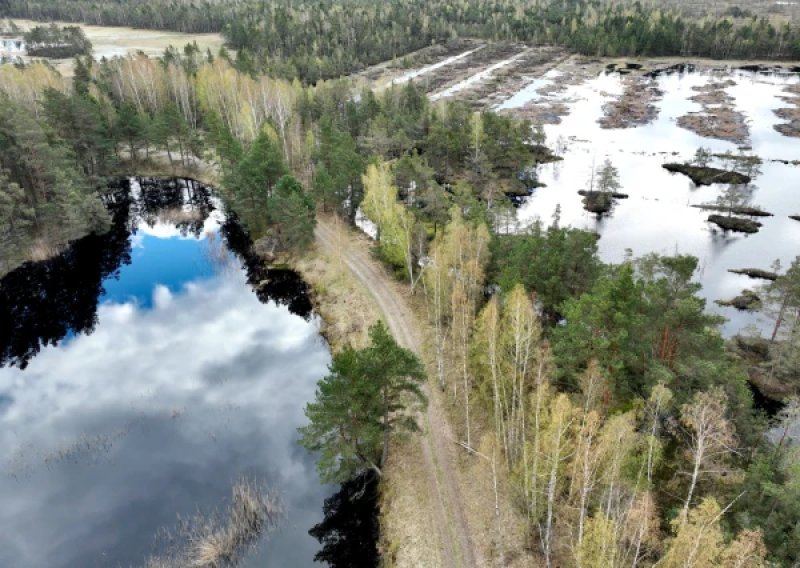
“The invasion of Latvia from the eastern side, through the current Latvian-Russian border, occurred only once — in 1577, when the army of Ivan IV the Terrible crossed the Livonian border at Vilaka and headed towards Jekabpils. However, such a mistake was not made again, as it was concluded that movement through the eastern areas of Latgale was too difficult.” “Historically, subsequent invasions by the eastern neighbor into Latvian territory occurred either from Southern Estonia, from the vicinity of Valka/Valga, or from Lithuania, from Biržai, Šiauliai.” Kuzmins notes: “The best obstacle is a forest flooded with water one and a half meters deep. The best kind has underbrush of shrubs. Such a forest is impassable by any means, and this is what the Ukrainians did in March 2022 near Kyiv by blowing up a pumping station on the Irpin River. A flooded area formed for hundreds of kilometers. Such solutions are the most reliable.” Comparing the situation of 1939–1940 and the present, the expert argues that “the USSR had no difficulty blocking the Latvian and Estonian coasts and the airspace of all three Baltic states.” Currently, the situation is fundamentally better for the defending side: “The Baltic Sea has become a ‘pond’ where one cannot hide or escape. This is what we see in the war in Ukraine in the Black Sea. Estonia has anti-ship missiles. Latvia has signed contracts for their acquisition. The Russian fleet will not go beyond Kronstadt. This is a story about expensive, high-quality combat means. The same goes for airspace. And we see the same in Ukraine — Russian planes do not approach within 50 kilometers of the contact line... Yes, Russian ballistic missiles are a problem. In Iran, the U.S. tried to deal with the missile problem by bombing launchers. Not to catch arrows, but to get the archer. This can be done.”
