

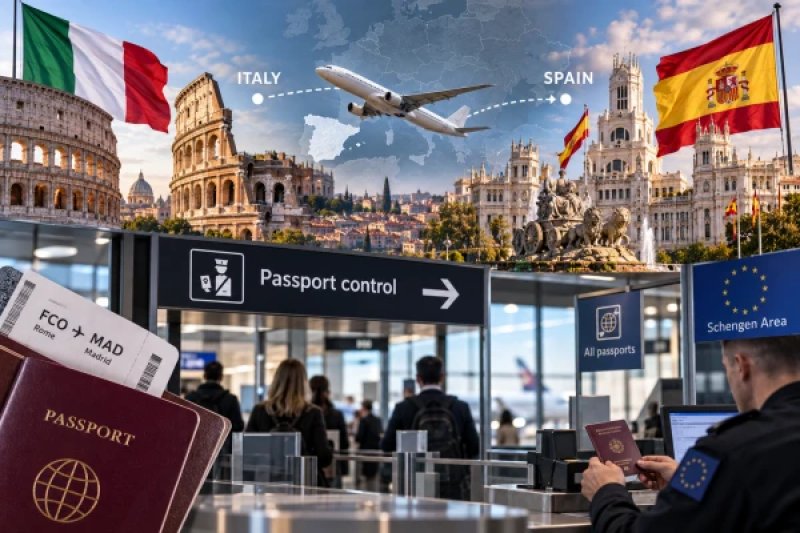
The authorities of Italy and Spain have announced a new extension of temporary border control between the two countries. The restrictions, introduced in the summer after the migration crisis in the Spanish enclave of Ceuta, will remain in effect for at least a few more weeks. Although Italy and Spain are part of the Schengen Area and do not share a land border, passengers arriving by air still go through passport control, which is absent under normal free movement conditions. Italy has reported that it is extending the control for another 15 days. The country's Ministry of the Interior explained the decision by the continuing risks to internal security, as well as a potential terrorist threat. Spain, for its part, stated that it would maintain similar measures until October 8, noting that the reasons for the control introduced earlier remain relevant. The reason for the restrictions was the migration crisis in Ceuta. On July 30 and 31, more than 70,000 illegal migrants arrived in the Spanish enclave from Morocco. Following this, on August 1, Italy temporarily suspended the application of Schengen rules for arrivals from Spain. A week later, on August 8, similar measures were introduced by the Spanish side. For travelers, this means that despite the Schengen Agreement, when flying between Italy and Spain, one must be prepared for document checks at the border. At the same time, as noted by DPA, most migrants soon returned to Morocco; however, several thousand remain in Ceuta. The agency also points out that there have been no reports of attempts by migrants who arrived in the enclave to reach Italy, and free movement from Ceuta to mainland Spain is restricted for them. The decision of the Italian authorities has sparked a political debate within the country. Critics of Prime Minister Giorgia Meloni's government argue that the continuation of border control has a political underpinning. The Italian authorities, for their part, explain the extension solely by security considerations.
