

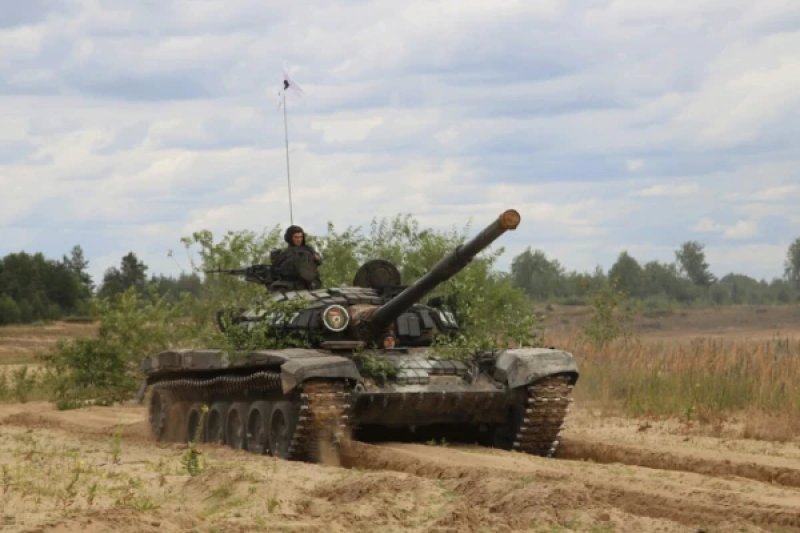
The maneuvers are being conducted under the leadership of the Chief of the General Staff of the Armed Forces of Belarus. Military command bodies, tactical units, and individual parts are involved, including mechanized and tank units. According to the Ministry of Defense of Belarus, the main goal of the exercises is to check the readiness of the staffs and troops for the preparation and conduct of a strategic operation. The agency emphasizes that the maneuvers are included in the army's training plan for 2025–2026 and are aimed at protecting the sovereignty and territorial integrity of the country. The exact number of participating servicemen and the equipment involved is not disclosed. Minsk claims that the scale of the exercises does not exceed the threshold values established by the 2011 Vienna Document, under which a state is obliged to notify other countries in advance. ## What Belarusian Military is Practicing The program of the maneuvers includes guarding the state border, using unmanned aerial vehicles, searching for and destroying sabotage and reconnaissance groups, and illegal armed formations. Units are also training to repel attacks using drones, light aviation, and other means of aerial assault. Part of the exercises is taking place at the Hozhsky, Brest, and Ruzhansky training grounds. The Hozhsky training ground is located directly near the Lithuanian border, the Brest training ground is about 15 kilometers from Poland, and the Ruzhansky training ground is approximately 60 kilometers away. ## Special Attention to the Suwalki Corridor The location of the training grounds attracts increased attention from NATO countries, as the maneuvers are taking place in the area of the Suwalki Corridor — one of the most vulnerable sections of the eastern flank of the alliance. This segment of the Polish-Lithuanian border, about 100 kilometers long, provides land communication between Lithuania, Latvia, and Estonia with the rest of NATO territory. At the same time, it separates Belarus and the Russian Kaliningrad region. A possible blockade of this area in the event of an armed conflict could seriously complicate the transfer of allied forces and supply to the Baltic states. Therefore, any military activities near the corridor are closely monitored by Poland, Lithuania, and other NATO members. ## Exercises are Ongoing Almost Continuously The current maneuvers have become part of a broader check of the Belarusian security sector. On September 11, Alexander Lukashenko visited the Obuz-Lesnovsky training ground near Baranovichi and stated his intention to assess the readiness of the entire defense system of the state. Since the beginning of the full-scale war of Russia against Ukraine, military exercises on the territory of Belarus have been held regularly. Previously, Russian units have also participated in them multiple times. Belarus has not officially sent its troops to the war against Ukraine. However, since February 2022, Minsk has been providing Russia with territory, military infrastructure, and airspace. Belarusian enterprises are also fulfilling orders from the Russian defense complex — it is estimated that more than 100 companies are involved in such cooperation. Recently, the Ukrainian border service stated that Russian troops are using relay stations located in Belarus to control drones attacking targets in western Ukraine. The Belarusian authorities present the exercises as planned defensive training. However, the location of the exercises, the participation of tank and mechanized units, as well as the practice of operations using drones make the maneuvers an important security factor for Poland, Lithuania, and the entire Baltic region.
