

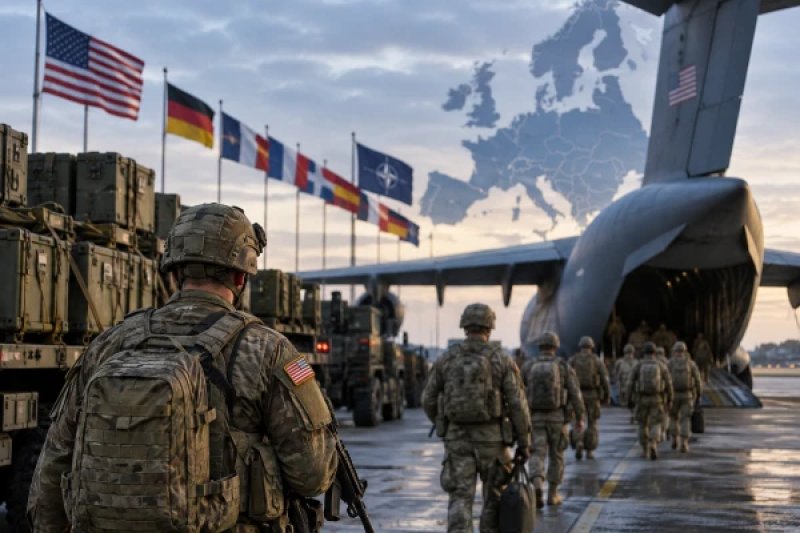
The Pentagon is considering withdrawing up to 25,000 American troops from Europe. The U.S. may significantly reduce its military presence in Europe. The Pentagon is considering the withdrawal of about As reported by [Reuters](https://www.reuters.com/investigations/trumps-pressure-nato-is-reshaping-europes-defenses-will-it-break-alliance-2026-09-17/?utm_source=chatgpt.com), there are currently **more than 81,000 American servicemen** in Europe. Their numbers fluctuate due to rotations, exercises, and temporary deployments of units. Back in June, U.S. Secretary of Defense Mark Esper intended to announce a reduction of about **25,000 servicemen**, two American officials told Reuters. However, this initiative faced resistance within the Donald Trump administration. Instead of an immediate reduction, the Pentagon began a six-month review of the entire system of U.S. force placement in Europe. According to [ANSA citing NBC News](https://www.ansa.it/sito/notizie/mondo/2026/09/17/nbc-pentagono-valuta-di-ritirare-25.000-soldati-dalleuropa_da0c08bf-2fbc-4537-8637-db9d8dae4df2.html?utm_source=chatgpt.com), not only the withdrawal of troops is being considered, but also of aircraft, ships, and weapons. One option involves reducing about a third of the American contingent — around 25,000 personnel. However, some NBC sources suggest an even larger scenario — up to 40,000 servicemen, nearly half of the current grouping. If such an option is implemented, it would be one of the most significant reductions of American military presence in Europe since the end of the Cold War. ### No Decision Yet The review of the American military presence began in June and is expected to be completed by the end of the year. According to Reuters, among the options realistically considered by the Pentagon is a reduction of about 25,000 personnel. The process has already raised concerns in the U.S. Congress. Democratic Senator Jeanne Shaheen, who holds a leading position on the Senate Foreign Relations Committee, has urged Secretary of State Marco Rubio to ensure the involvement of American diplomats in the review of military presence. She specifically pointed to Latvia, Lithuania, and Estonia. According to Shaheen, even changes that may seem minor from a purely military perspective can seriously affect U.S. relations with the Baltic states amid Russia's actions on NATO's eastern flank. The State Department, for its part, disputes the claim that diplomats have been sidelined from the process, stating that American ambassadors and other representatives of the department are participating in consultations. ### At the Same Time, the U.S. May Strengthen Its Presence in Poland The situation looks particularly interesting against the backdrop of another statement from Washington. On September 17, President Donald Trump announced progress in negotiations for the establishment of a permanent U.S. Army base in Poland. If an agreement is reached, the location is promised to be announced soon. Poland has long sought a larger and more permanent American military presence on NATO's eastern flank. Currently, American units are stationed there primarily on a rotational basis. Thus, the discussed plan does not necessarily mean a uniform withdrawal of the U.S. from Europe. One possible outcome could be a change in the geography of American presence: a reduction in overall numbers while maintaining or strengthening forces in strategically important areas of NATO's eastern flank. Reuters notes that Poland and Romania are actively seeking to retain American troops on their territory.
