

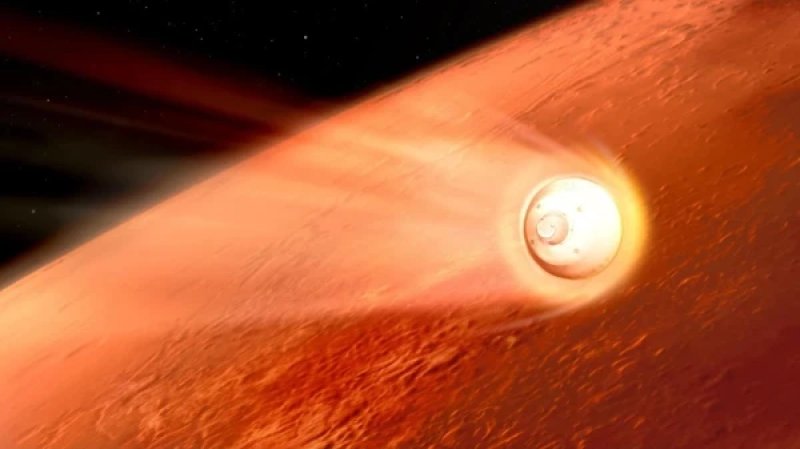
Even space debris can be useful for science. This conclusion was reached by researchers who studied five craters that appeared on Mars after the landing of the Perseverance rover as part of the Mars 2020 mission. During the landing preparation, the spacecraft dropped two tungsten ballast weights weighing 77 kilograms each, and later debris from the upper stage fell to the planet's surface, totaling about 540 kilograms. All these objects struck the ground and created five small craters. Instead of considering these marks a side effect of the mission, scientists decided to use them as a unique experiment. The results of the study were published in the journal [Geophysical Research Letters](https://agupubs.onlinelibrary.wiley.com/doi/10.1029/2026GL122337). ## Why these craters are particularly valuable Typically, researchers study craters left by natural meteorites. However, it is nearly impossible to accurately determine the mass, speed, and angle of impact of a space rock. In the case of NASA's equipment, all these parameters were known in advance. This allowed for a significantly more accurate calculation of the impact consequences and comparison of the actual results with computer models. The five new craters were discovered in images from the Mars Reconnaissance Orbiter. Researchers confirmed that they appeared after 2020, as there were no traces of them in earlier photographs. ## What was discovered The analysis showed that existing models overestimate the strength of the Martian surface. According to scientists' calculations, the cohesion strength of Martian soil is about 7 kilopascals, which corresponds to very loose sandy material that resembles dry sand and easily crumbles. The authors of the study note that standard models can be off by nearly an order of magnitude when it comes to impacts from dense objects on loose surfaces at shallow angles. This became the main scientific result of the work. ## Why the impact site was interesting The debris fell about 70 kilometers from the Jezero crater, where the Perseverance rover has been operating for several years. This area is considered one of the most promising places to search for traces of ancient life. Billions of years ago, there was a river and delta here, which means conditions may have been favorable for the existence of microorganisms. ## Not the first experiment with impacts Using impacts for scientific research has long been one of the tools of planetary science. For instance, the Japanese Hayabusa2 mission specifically created a crater on the Ryugu asteroid to study its internal structure. The DART mission first altered an asteroid's orbit with a kinetic impact, and recently, a spent stage of the Falcon 9 rocket struck the Moon's surface. The authors of the new work believe that a similar approach can be applied in future expeditions. Even elements of spacecraft that were previously considered useless debris can become a source of valuable scientific information. In the future, scientists hope to use a similar methodology to study natural meteorites falling on Mars. If their characteristics can be determined in advance by observing their entry into the atmosphere, such impacts could provide even more information about the structure of the Martian surface. The study showed that even accidentally left traces on another planet can become a full-fledged scientific experiment and help better understand the nature of Mars.
