

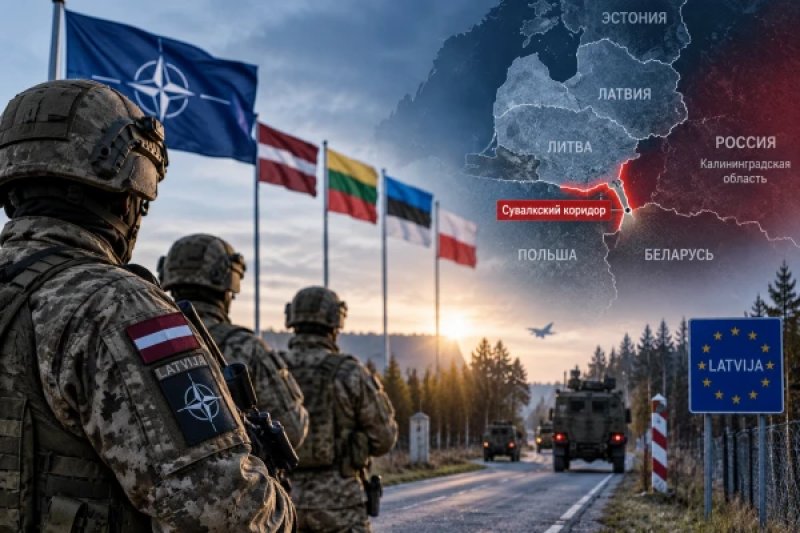
In Europe, there is an increasing seriousness regarding the possibility that the war in Ukraine, in one form or another, could extend beyond the current borders of the conflict. NATO countries are strengthening critical infrastructure, revising civil defense plans, and preparing hospitals, energy, transportation, and communication for operation in emergency conditions. Against this backdrop, particular attention is once again focused on the Suwalki Corridor — a narrow stretch of the Polish-Lithuanian border between Belarus and the Russian Kaliningrad region. It is the only land connection for Lithuania, Latvia, and Estonia with the rest of NATO countries. This is reported by CNN's international affairs analyst Brett McGurk, who previously held high positions in U.S. national security under several American presidents. ### Why the Talk of a Major War The reason for the growing concern is a series of events. Russia and Belarus are conducting military exercises near the Suwalki Corridor. At the same time, European governments are enhancing the protection of strategically important facilities in the face of diversions, cyberattacks, the emergence of drones, and other incidents that the West associates with Russian hybrid activity. As CNN notes, the peculiarity of such actions is that they can remain below the threshold of open military attack. A drone in NATO airspace, disruption of airport operations, damage to infrastructure, a cyberattack, or a diversion do not, in themselves, signify the beginning of a major war. However, a series of such incidents could pose a difficult question for the alliance: at what point should what is happening be considered an attack requiring a collective response? CNN identifies this uncertainty as one of the main problems for NATO. ### The Vulnerable 100 Kilometers On the map, the Suwalki Corridor appears to be a relatively small stretch of territory — its length is approximately 100 kilometers. However, its strategic significance is enormous. On one side is Belarus, and on the other is Russia's Kaliningrad region. And through the territory of Poland and Lithuania runs the land connection of the Baltic states with the rest of NATO. In the event of a serious military crisis, this stretch becomes particularly important for the transfer of people, equipment, and cargo. CNN considers a hypothetical scenario in which Russia — possibly in conjunction with Belarus — could conduct a limited operation in the corridor area. In this case, Moscow, the author of the analysis suggests, could present the incident as a local occurrence while simultaneously warning that a large-scale NATO response could lead to further escalation. It is important to emphasize: this is not about a confirmed plan for an attack, but rather a scenario used in analyzing the vulnerability of NATO's eastern flank. The main question in such a case would not only concern the fate of the Suwalki Corridor itself. The readiness of all NATO countries to fulfill their collective defense obligations would also be put to the test. ### What Will Happen to Latvia For Latvia, Lithuania, and Estonia, the significance of this stretch is particularly great. The Suwalki Corridor remains their only land connection with the rest of the alliance's territory. This does not mean that in the event of problems in this direction, the Baltic states would automatically find themselves completely isolated: maritime and air routes remain, and allied forces are already present in the region. Nevertheless, the land route is fundamentally important for the rapid transfer of large units, heavy equipment, ammunition, and other resources. NATO Secretary General Mark Rutte previously stated that the alliance regularly practices scenarios related to the potential threat to the Suwalki Corridor. According to him, an attack on NATO territory would provoke a response from the alliance. But CNN points out another factor — the position of the United States. ### The Key Question — What Will Washington Do The United States is simultaneously forced to allocate military resources among several strategic directions. In addition to Europe, Washington must consider the situation in the Middle East and the confrontation with China in the Indo-Pacific region. This concerns not only military personnel. Air defense systems, ships, reconnaissance assets, and ammunition stocks cannot be held in unlimited quantities in all regions of the world at the same time. According to the CNN author, it is the doubts about Washington's possible reaction that become one of the factors prompting European states to take their own security more seriously. ### Europe is Preparing Not Just Armies There is another fundamental change. Preparation for a possible conflict is now not limited to the procurement of tanks, missiles, and ammunition. The experience of Ukraine has shown European countries how important it is for a state to continue functioning after strikes on energy and other infrastructure. Electricity must reach homes, hospitals must accept patients, communication must work, transportation must move people and goods, and government institutions must perform their functions even in the face of a prolonged crisis. That is why NATO is updating its requirements for the resilience of alliance countries. The focus is on energy supply, food and drinking water, medicine, transportation, communications, and the continuity of government operations. ### Deterrence Begins in Peace Time The logic of current preparations is not only to be able to respond to a possible attack. The task is to convince a potential adversary that even a limited attack or an attempt to create a crisis will not yield the desired result. Therefore, military exercises, strengthening the eastern flank, protecting power plants and airports, preparing hospitals, and creating backup communication systems become parts of a single strategy. For the Baltic states, this issue is particularly sensitive due to the geography of the region. And the Suwalki Corridor remains that point on the map of Europe where geography is particularly intertwined with the question of NATO's ability to protect its members. That is why this small strip of the Polish-Lithuanian border is once again at the center of a major European discussion about security.
