

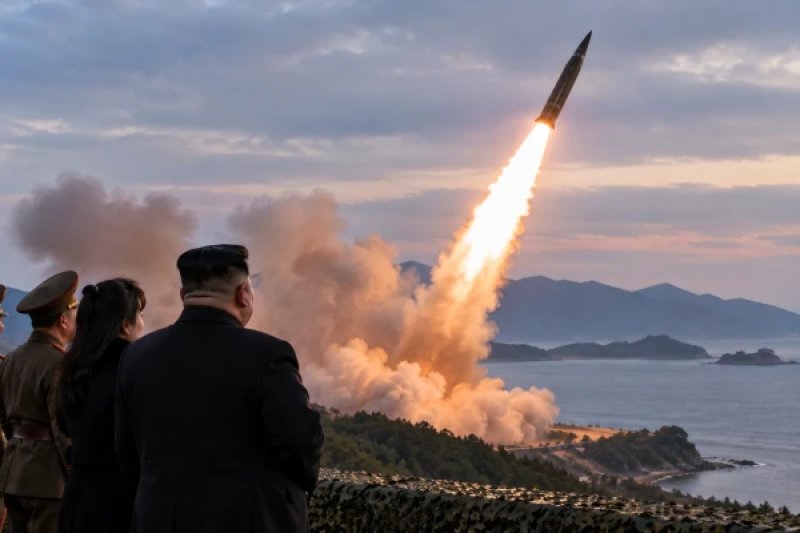
### What Exactly Did North Korea Test The test took place on **September 20**, and the official announcement from the North Korean agency KCNA appeared on the morning of September 22. The North Korean missile command stated that the test is of "great significance" for the development of new weapon technologies. Kim Jong Un and his daughter observed the launch. The name of the system is not directly mentioned in the KCNA report. However, one of the published images shows the inscription **Hwasongpho-11Ma-1** on the screen. South Korean experts believe this may be a further development of North Korea's short-range missile with a hypersonic glide vehicle. Reuters, citing specialists from NK News, also notes that the appearance of the device indicates a modified version of the missile with a **hypersonic glide vehicle**. ### Why Such a Missile is Harder to Intercept The main feature of such a design lies not just in its high speed. After launch, the warhead is capable of changing its trajectory and maneuvering, making it more difficult for missile defense systems to predict its path and organize an interception. Therefore, it is more accurate to say that the new system **may be designed to complicate the work of missile defense**, rather than asserting that it is guaranteed to overcome it. There is currently no independent confirmation of all the characteristics claimed by North Korea. An interesting detail was discovered directly in the North Korean photographs. One of the screens shows figures of **908.2 km range, 35.8 km altitude, and speed of 2146 m/s**. The South Korean agency Yonhap notes that these data differ from the initial assessments of the South Korean military, so they should be treated with caution. ### Two Missiles Launched Hours Apart The South Korean military recorded the launch of **two short-range ballistic missiles** from the Wonsan area towards the Sea of Japan on September 20. According to South Korean estimates, one flew about 450 km, while the other traveled more than 600 km. Thus, the range data claimed by Pyongyang differs from the observations made by Seoul. Yonhap specifically points out that inaccuracies in the figures displayed by North Korea on the published telemetry screen cannot be ruled out. ### Kim Promised Opponents a “Chronic Headache” Kim Jong Un described the test as a demonstration of modern defense technologies and evidence of the modernization of the armed forces. According to KCNA, he stated that the emergence of such technology should become a **“chronic headache”** for the country’s adversaries. The tests took place against the backdrop of renewed rhetoric surrounding the Korean Peninsula. Pyongyang accuses the United States of increasing tensions due to military exercises. In turn, the foreign ministers of the United States, South Korea, and Japan met on the sidelines of the UN General Assembly and agreed to continue coordinating on security issues concerning the peninsula. So far, North Korea has not disclosed enough data to independently assess the real capabilities of the new weapon. However, the published materials indicate the continuation of work on **maneuverable missile systems designed, among other things, to complicate interception**. It is the ability of such a warhead to change its trajectory, rather than just its speed, that poses the greatest challenge to existing missile defense systems.
