

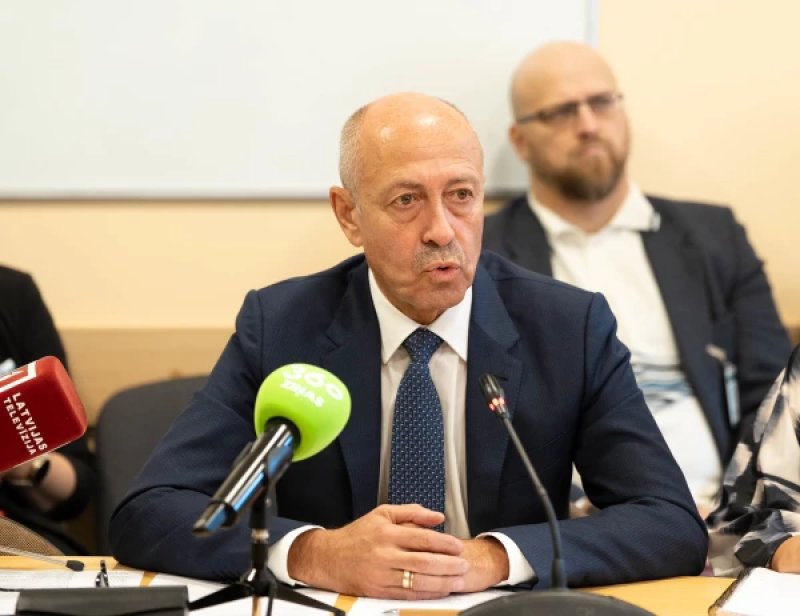
During a meeting of the Saeima's Commission on State Administration and Local Governments today, the issue of the impact of repair work on the Riga Cable-Stayed Bridge on mobility and access to services not only in Riga but also in the Riga municipalities was discussed. "The Commission received a letter from the Marupe municipality expressing concern about how the repair work on the Cable-Stayed Bridge is being planned, regarding the lack of information and the impact of potential traffic restrictions on mobility, access to services, and business activities in the Riga municipalities. Representatives of the client for the repair of the Cable-Stayed Bridge from the Department of External Space and Mobility of the Riga City Council, as well as representatives of the Marupe municipality, Riga business organizations and enterprises, experts from the State Joint Stock Company Latvijas Valsts ceļi, the Procurement Monitoring Bureau, the National Cultural Heritage Administration, and other stakeholders were heard in the commission. Meanwhile, the developer, the consortium of suppliers "Cable-Stayed Bridge," which received the right to reconstruction for nearly 70 million euros, refused to attend the commission meeting. The supplier consortium includes Hanza Construction Group Ltd., Tilt Ltd., and Baltic Bureau for the Design of Artificial Structures "Vector T" Ltd. "During the meeting, concerns were confirmed that the Riga municipality currently does not have a clear plan for organizing traffic during construction work, and the deputies did not receive confirmation that a comprehensive technical inspection of the bridge had been conducted, or a special inspection, which is an important condition for developing a quality and long-term reconstruction project. In this context, the refusal of the builder to attend the Saeima commission meeting is particularly indicative," noted Burov. At the commission meeting, entrepreneurs and representatives of the Marupe municipality expressed the opinion that they should be involved in the daily planning of repair work on the bridge. Deputies and stakeholders agreed on the lack of information regarding the repair work on the bridge. "The planning of repair work on the bridge should be open, and municipalities and entrepreneurs from the surrounding areas should also be involved. The Riga City Council should provide the public with regular information on the progress of planning, potential traffic restrictions, and alternative routes. A significant majority of deputies and experts also emphasized the need to ensure a temporary bridge for the entire period of repair work," explained O. Burov. "After the agenda of the Saeima commission was made public, which included the issue of repair work on the Cable-Stayed Bridge, within two days, the Riga City Council held a press conference to inform about the planned repair works. This is already a certain success of the Saeima commission's work - thanks to our activity, the municipality is starting to communicate with its residents. The Saeima should keep an eye on both the repair of the Cable-Stayed Bridge and other major projects in the municipalities. This makes the processes more transparent and helps the public receive information and intervene in a timely manner if necessary," said the commission chairman. During the commission meeting, concerns were also raised about the decisions outlined in the preliminary design for the reconstruction of the bridge, which reduce the bridge's capacity, as the number and width of traffic lanes will be reduced, while bike lanes will be equipped on both sides instead. Deputies noted that there are already problems with traffic jams in Riga caused by ill-considered decisions that narrow and eliminate traffic lanes. The problem has worsened, and traffic jams occur even outside of usual peak hours, which harms the economy and pollutes the environment. The Saeima Commission on State Administration and Local Governments calls on the Riga City Council to: 1. First ensure the construction, commissioning, and opening of a temporary bridge for traffic and only then begin construction work, which requires the closure or significant restriction of traffic on the Cable-Stayed Bridge. 2. Ensure a comprehensive and technically justified reconstruction of the Cable-Stayed Bridge, assessing the feasibility of the proposed solutions and the scope of necessary work, and including all work necessary to ensure the load-bearing capacity, reliability, and longevity of the bridge. The scope of work should be planned in such a way as to eliminate the need for significant reconstruction work in the foreseeable future due to such structures or elements whose restoration or replacement is identified during the preparation of the current reconstruction. When choosing reconstruction solutions, do not reduce the portion of the roadway designated for motor vehicles and ensure that the bridge's capacity for motor vehicles is not reduced after reconstruction, while also assessing the possibilities for its increase. 3. Coordinate the schedule of construction work and the organization of traffic with Latvia's presidency in the Council of the European Union in 2028 and the Song Festival. 4. Timely inform the public and Riga municipalities about the decisions made regarding traffic organization, the readiness of alternative infrastructure, and the timelines for the planned restrictions. And also call on the Ministry of Transport and the Ministry of Finance to assess alternative mobility solutions to reduce traffic intensity in Riga, paying special attention to the establishment of mobility points in the Riga district and the possibilities, if necessary, to provide financial support for their establishment.
