

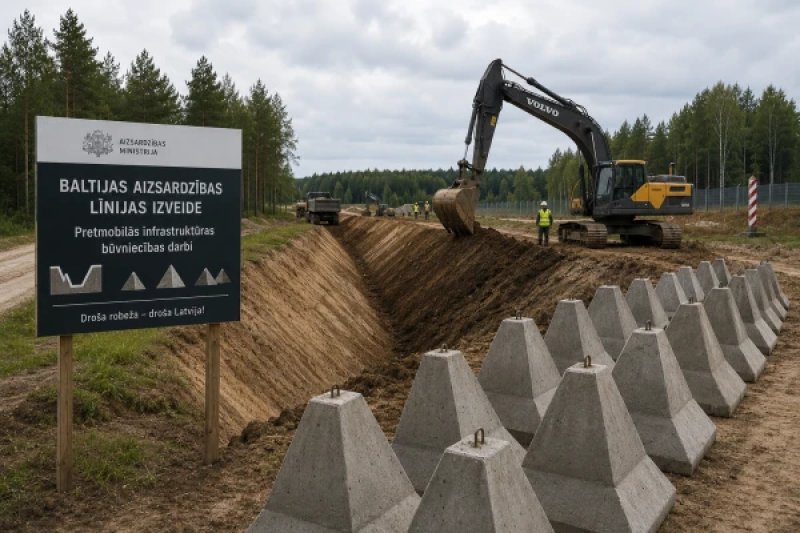
Work on the creation of the Baltic defense line on Latvia's eastern border has entered an active phase. In border areas, so-called ‘dragon teeth’ are already being installed, anti-tank ditches are being dug, and other engineering obstacles are being prepared, public media report. The National Armed Forces emphasize that concrete obstacles are just one element of the future defense system. It also includes the possibility of installing minefields, using various sensors, organizing fire support, and interacting with the State Border Guard. Initially, 303 million euros are allocated for the implementation of the project to strengthen the eastern border over five years. Currently, hundreds of reinforced concrete obstacles are stored at the site of the former airfield in Padejze, Alūksne municipality, which will be delivered closer to the state border as needed. "These obstacles are installed in open areas that would otherwise be easily crossed by tracked and wheeled vehicles. When rows of 'dragon teeth' are combined with an anti-tank ditch, the enemy's equipment will physically be unable to overcome them without special engineering devices," said Sergeant Adolfs Grīns, a representative of the engineering company of the 2nd Vidzeme Brigade of the National Guard. The total length of Latvia's border with Russia and Belarus exceeds 450 kilometers. However, concrete barriers will not be placed in a continuous line. They are installed only in areas where the terrain allows heavy equipment to move. The production of ‘dragon teeth’ began in August, and large-scale installation work and construction of anti-tank ditches started in September. According to Dace Plotniece, head of the Department of Foreign and Border Projects at VNĪ, a total of 13 thousand reinforced concrete obstacles are planned to be manufactured. To date, about 7,500 have already been produced. "On average, one 'dragon tooth' is produced and delivered every one and a half minutes," Plotniece noted. Currently, work is most actively being carried out in the Balvi municipality. About two kilometers of anti-tank ditches have already been dug there, and concrete barriers have been installed over approximately one kilometer. Moreover, the defense line will not be limited to the border strip. Some facilities intended to restrict the movement of equipment and ensure defense are planned to be placed deeper within Latvia's territory. This means that the implementation of the project will require the use of not only state land but also plots owned by municipalities and private owners.
