

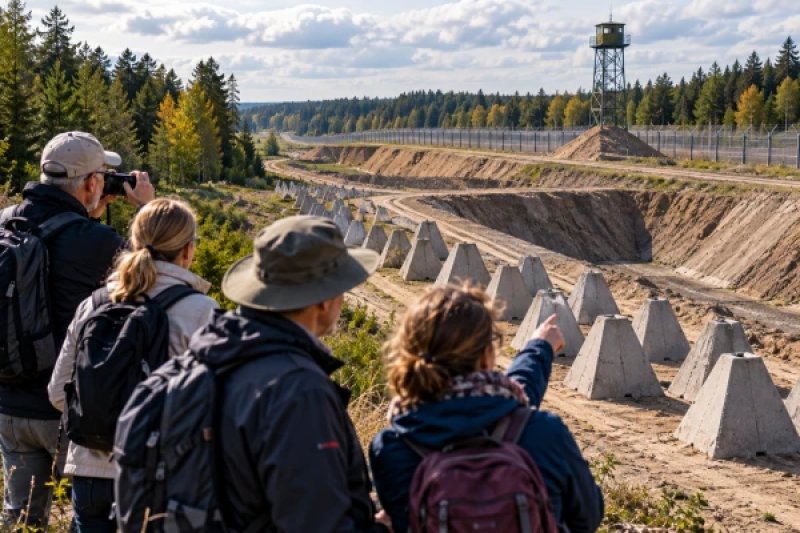
This is reported by the Estonian public broadcaster ERR. There is particularly noticeable interest from foreign travelers: they ask guides where they can see elements of the Baltic defense line and how close they are allowed to approach the border. ### Guides Had to Change Routes The border area of Võrumaa County and the historical region of Setomaa has become especially popular. Previously, visitors came mainly for the local culture and nature, but now travelers have a new point of interest — the new defensive infrastructure. Guide and tour organizer Helen Alumaa told ERR that this summer she had to **adjust excursion routes multiple times due to tourists' desire to see the fortifications**. Groups approach the border structures at the permitted distance, and guides tell them about anti-tank ditches and show them the concrete "dragon's teeth." Not far from the village of Meremäe, just a few kilometers from the Russian border, anti-tank ditches and a defensive embankment have already appeared on private land. These structures are particularly attractive to foreign guests. ### "Aren't You Scared Here?" But foreigners are interested not only in the fortifications themselves. According to the owner of a local farm, Kaidi Kerdt, visitors regularly ask residents **how safe it is to live near the Russian border and whether they fear a possible military threat**. Locals have to explain to tourists that they feel safe and that police and border guards are constantly working in the border area. At the same time, Estonian tourists, according to observations from Setomaa residents, show significantly less interest in such questions. ### Up to 600 Bunkers and 40 Kilometers of Ditches The fortifications that tourists now consider are part of the **Baltic defense line** — a joint initiative of Estonia, Latvia, and Lithuania. The defense ministers of the three countries agreed on its creation in January 2024. Each country is building its own system of fortifications. In Estonia, it is expected to include **up to 600 concrete bunkers**, anti-tank obstacles, barbed wire fences, and engineering supply depots. Additionally, it is planned to construct **up to 40 kilometers of anti-tank ditches** over the next few years. The first bunkers are already being installed in the southeast of the country. According to official data, they are designed to protect military personnel inside from direct hits by 152-millimeter artillery shells. At the same time, the Estonian Ministry of Defense emphasizes that the construction of fortifications **does not indicate an immediate military threat**. Their purpose is to prepare infrastructure in advance that, in the event of a conflict, should hinder and slow down the enemy's advance and provide time for the deployment of defense forces and allies. The irony of the situation is that the structures intended for the most serious scenario — a possible war — have unexpectedly taken on a completely different function in peacetime: they have become a tourist attraction in the Estonian border region.
