

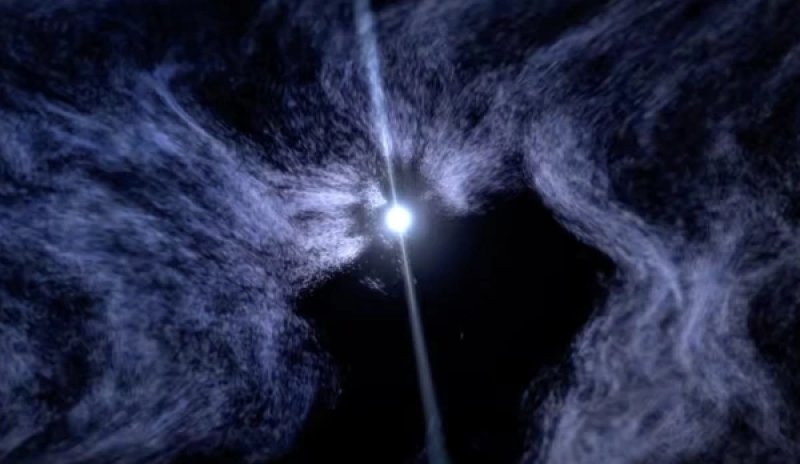
An international team of researchers has directly observed for the first time how a neutron star captures material ejected by its companion star. Until now, scientists had only seen the beginning and end of this process, while what happens in between remained hidden. The subject of the study was the unusual binary system BP Crucis, located in our galaxy. It consists of the blue hypergiant Wray 977, which has a mass approximately 40 times that of the Sun, and the neutron star GX 301-2 — a super-dense remnant of a supernova explosion. Despite having a diameter of only about 20 kilometers, the neutron star has a mass comparable to several solar masses and completes a full rotation around its axis in 11 minutes, emitting regular radio signals. For this reason, it is classified as a pulsar. ## They Managed to See What Was Previously Hidden The observations were carried out by the new X-ray space observatory XRISM, developed jointly by NASA and the Japan Aerospace Exploration Agency (JAXA). Using a high-precision spectrograph, scientists were able to determine the composition of the material falling onto the pulsar and measure its velocity. It turned out that the flow of stellar wind, consisting mainly of hydrogen and helium, is rushing toward the neutron star at a speed of about 540,000 kilometers per hour. ## How the Pulsar “Feeds” The study showed that while moving along its 41.5-day orbit, the pulsar constantly passes through a dense stellar wind surrounding the blue hypergiant. Part of this material is captured by the gravity of the neutron star and forms an accretion disk around it. The material then gradually falls onto the surface of the pulsar, after which the disk begins to form anew. This process repeats cyclically. According to one of the authors of the study, Roy Rahin from the University of Maryland and NASA's Goddard Space Flight Center, they were able to observe the intermediate stage of this process for the first time. > "This is the first case where we observe the material of the stellar wind at the moment it falls onto the neutron star," noted the researcher. ## Why This Is Important Until now, astronomers could study either the stellar wind far from the neutron star or the material already at its surface, where it is captured by a powerful magnetic field. The new work allowed for the first time to explore the region between these two stages — at a distance of approximately 100,000 to one million kilometers from the neutron star. This area is considered key to understanding how pulsars acquire the material that then becomes the source of their powerful X-ray emissions. ## This Is Just the Beginning In December of last year, astronomers again observed the BP Crucis system using XRISM. According to the researchers, the new data turned out to be "even more astonishing and interesting," so new results are expected to be published soon, which may significantly expand scientists' understanding of the behavior of neutron stars. The study is published in the journal [Science Advances](https://www.science.org/doi/10.1126/sciadv.aef6686). ## Why This Is Important Neutron stars are considered some of the most extreme objects in the universe. Understanding how they capture and absorb material will help to more accurately explain the origin of their powerful emissions and test current models of stellar evolution.
