

 Foto: BB.LV / Школа
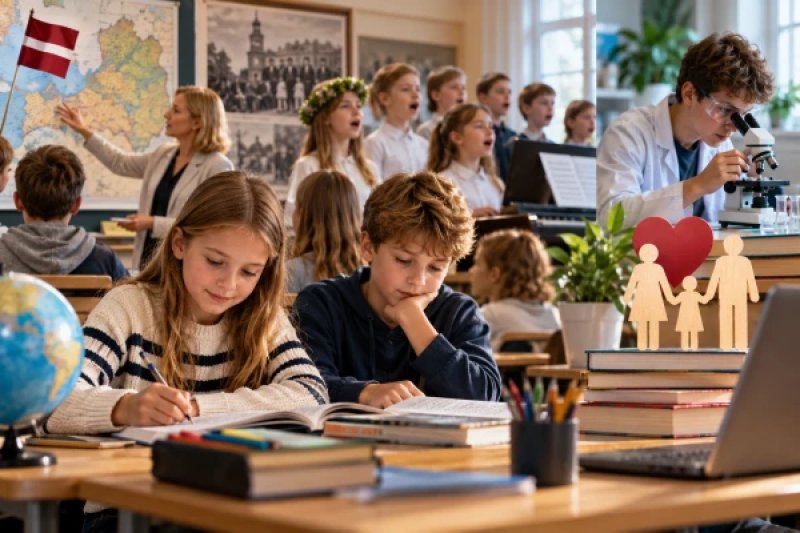
The proposals are outlined in an information report by the Ministry of Education and Science (MoES). It is not about abandoning Skola2030, but about reviewing and clarifying its content. ### More Emphasis on Latvia's History One of the notable changes concerns history. The programs for grades 4–9 have already been revised to make the study of Latvia's history more coherent. The National Alliance, which oversees the ministry, states that history may be taught as a separate subject in grades 4–6. A separate history course is also proposed for vocational education programs. The updated programs for social studies, social knowledge, and the history of Latvia and the world are expected to become established state standards. Their implementation in schools is planned to begin in the 2027/2028 academic year. ### Less Theory — More Singing Changes are also being prepared in music education. The program has reduced the share of theory, with more time expected to be devoted to practical music-making and singing. Special attention is planned for the development of school choirs, which should contribute to the continuation of Latvia's Song Festival tradition. ### A New Block on Family and Health May Appear in Schools A roadmap for the introduction of education on family health issues has been developed. The complete integration of this block into the curriculum is expected to occur from the 2028/2029 academic year. Students are to be provided with knowledge about family and responsibility, personality, self-esteem and emotions, puberty, friendship, conflicts and ways to resolve them, relationships, as well as physical and emotional development. However, questions have already arisen around this part of the project. The documents state that the module is to be developed in collaboration with the Society of History and Social Science Teachers. The organization itself indicated in its conclusion that it has not yet given consent for such collaboration and has not made a decision regarding participation in the development of the module. Additionally, the society wants a clear answer on how many teaching hours will be required for the new content, how to ensure the mastery of the already planned curriculum, and whether there will be any duplication of existing topics. At the same time, it is proposed to retain the content dedicated to financial literacy, national identity, civic participation, family values, as well as social, legal, economic, and political processes in society. ### Business Calls for More Attention to Natural Sciences The Latvian Chamber of Commerce and Industry (LTRK) believes that alongside history, collective singing, and family health, more attention should be paid to natural sciences. The organization, citing the latest PISA data, notes that the results of Latvian students in natural sciences are lower than those in Estonia and Lithuania, as well as below the average level of OECD countries. LTRK considers the presented plan too general: in the organization's opinion, it does not sufficiently detail specific actions, priorities, and expected outcomes. The chamber is also dissatisfied with the short time frame for discussing significant changes. Stakeholders were given time from September 22 to 25 for consultation. ### Major Changes — No More Than Once Every Five Years Minister of Education and Science Ilze Indriksonē states that it is necessary to move from individual improvements to a continuous enhancement of educational content based on data and research. Some updated programs are already being gradually used in schools starting this academic year — for example, in music, social studies, and history. Next summer, they are expected to be refined based on feedback from educators. The MoES also proposes to introduce a regular cycle for reviewing educational content. Significant changes are planned to be made no more than once every five years. At the same time, the ministry emphasizes that before serious changes, it is necessary to prepare teachers in advance, provide schools with teaching materials and digital resources, and ensure the necessary funding. Thus, there are no plans to cancel Skola2030. However, its content is intended to be significantly recalibrated — down to what knowledge a child should acquire in each grade and what place history, singing, and family health issues will occupy in the school curriculum.
