

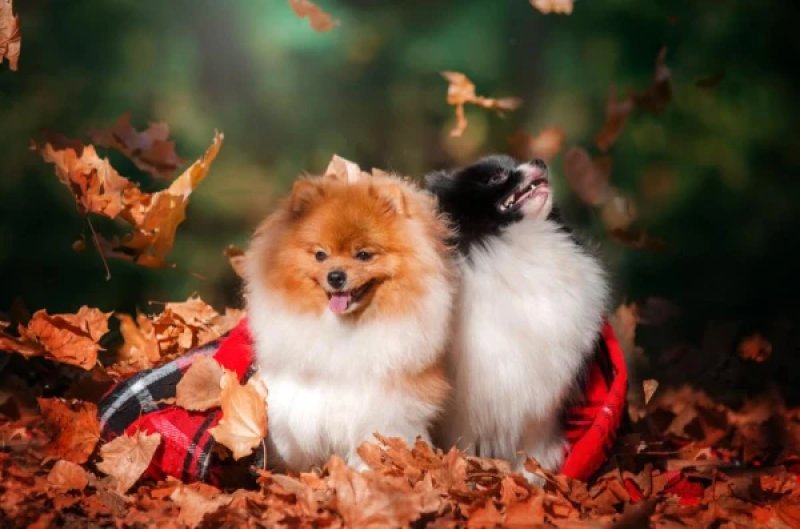
Features of the Fur Coat and the Need for Haircuts in Pomeranians Pomeranians have a dense and soft undercoat, as well as stiff, long guard hairs. The fur coat is positioned perpendicularly to the skin, creating a round, *cute* appearance. Grooming helps the dog remain *plush*, and the hairstyle is done once every 2-3 months. It is recommended to brush the fur at least once a week. Doing it more often is not advisable, as it may lead to bald patches. Mats usually form in the areas around the ears, *pants*, and armpits, so these areas should be given special attention. Shedding begins at 3-4 months, when the puppy fluff transitions to a dense undercoat. The fur coat gradually increases, and by the age of three, the Pomeranian's coat is considered fully formed. From this age, the pet stops growing and ceases to shed, and it can be taken to the *groomer*. Seasonal shedding occurs twice a year — in spring and autumn. The dog loses its undercoat and guard hairs. The advantage is that this process happens slowly, so there are no clumps of fur and fluff scattered around the house. During the shedding period, it is recommended to increase the brushing frequency to 2-3 times a week. When a Pomeranian Needs a Haircut Grooming is necessary in the following situations: Overgrown Fur — overly long hair hinders the miniature Pomeranian from running and moving. «Dirty» Season — after walks during rain and slush, the pet's fur mats, forming dirty tangles that are difficult to comb out. Temperature — during periods of intense sunlight (in spring and summer), Pomeranians feel uncomfortable outdoors. Due to their thick fur, the dog may suffocate and tire quickly during walks. Diseases — bacteria or insects can accumulate in the dense coat, which are difficult to wash off during bathing. When haircuts should be avoided: Shedding — some owners prefer to cut their dog shorter, but veterinarians recommend visiting a groomer after the final shedding. Protection — do not cut the dog in winter, as the hair and fluff provide protection against frost and bad weather. Heat — an overly short haircut makes the animal's skin vulnerable to sunburn and serious skin diseases. Haircuts can cause fear and aggression in Pomeranians, so the procedure is recommended only in cases of extreme necessity — no more than 2-3 times a year. Haircuts for Pomeranians Let's look at the most popular types of hairstyles for dogs of this breed. 1. Hygiene Cut During this procedure, the natural outlines of the breed are preserved: the dogs' fur is carefully trimmed around the ears, on the paws, and near the anus. This type of grooming is simple and can be done at home. We will discuss how to perform a home haircut later. 2. Short Haircut for Pomeranians A short hairstyle is generally a variation of the hygiene cut and can be performed by the owner. This procedure requires a minimal set of tools and a hairdryer. The fur is evenly trimmed along with the undercoat by 3-4 cm. It is not advisable to cut it shorter. 3. Classic This style is used for dogs that participate in exhibitions and competitions. The goal is to emphasize the animal's strengths and hide its weaknesses. The ears are given a rounded shape with scissors, and excess fur is removed between the pads and around the toes. The collar is shaped into a spherical form, and finally, the entire body is thinned out. 4. Modern This style resembles the classic but features significant shortening along the contour. As a result, the dog looks like a plush toy. It is better to entrust grooming to a professional, as shortening at home may damage the structure of the guard hairs. 5. Bear Cut This is the most popular hairstyle for Pomeranians, made famous by the dog Boo, who was groomed to look like a bear. Due to its cute appearance, this dog became known worldwide. A significant downside is that this hairstyle can affect the exterior and length of the fur. It is advisable to think carefully and consult with an experienced groomer. 6. Lion Cut This hairstyle is suitable for miniature breeds, including Pomeranians. The fur is shortened to the shoulders, leaving a mane-like collar. The thighs are shaved to the hock joints, and the front legs are shaved to the wrists. The belly is also completely shaved, and a tuft is left at the tip of the tail. However, one should remember the risk of damaging the fur coat, as the undercoat may mat, and the dog will look unkempt. After such experiments, it will not be possible to grow back the previous length. Differences for Boys and Girls There are no strict differences — the choice is up to the owner. Girls are usually not cut into a lion or bear style, preferring hairstyles that are closer to their natural shape. Individuality can be emphasized with accessories, clothing, collars, and leashes. Home Haircut Grooming is carried out in three stages: brushing, bathing, and cutting. During the procedure, the following rules should be observed: Brushing is always done against the direction of hair growth — from the crown to the tail. This allows access to the undercoat, where tangles usually form. The brush should be soft, sturdy, wooden, with thin and frequent teeth. Make sure that during brushing, the hairs do not break or get pulled out. The brushing process usually takes more than 10-15 minutes. Choose a brush with rounded and gentle teeth to avoid scratching the skin. Small scratches can become infected and cause discomfort for the dog. To remove tangles and knots, it is advisable to use a special spray. For the cutting procedure, choose a cozy place where the pet will feel calm. For bathing, use special shampoos for dogs with undercoats. An anti-static spray will also be useful during cutting. A terry or linen towel is suitable for drying. The fur of Pomeranians dries poorly, so a hairdryer may be needed. For cutting, do not use clippers or trimmers, only scissors, to ensure smooth transitions. Step-by-Step Scheme Ears — pinch the edge and trim the protruding hairs to the desired length.Collar — groomers usually use a circular method for cutting the head. In front, align the hairs down with a comb, and for the nape, comb back. If the shape is satisfactory, move with scissors from the collar to the crown, setting the desired shape for the continuation of the semicircle. Body — comb the fur into two parts along the growth line and remove excess hairs with scissors.Tail — comb, divide the fur into two parts, and trim the longest and protruding hairs. Paws — remove the protruding hairs between the pads of the toes. In the end, you can go over with thinning scissors to smooth out any irregularities and flaws.
