

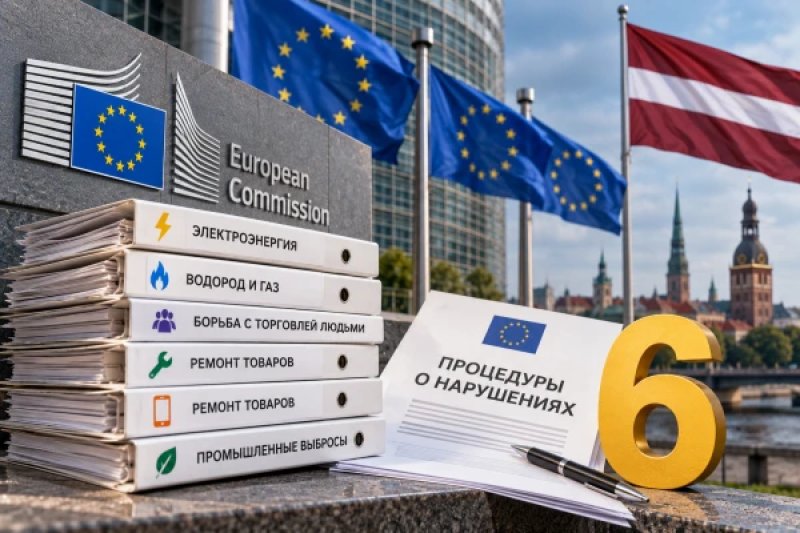
According to the press service of the European Commission's representation in Latvia, in all six cases, the deadlines for transposing European norms have already expired, but Latvia has not reported full compliance with the requirements. ## Free Choice of Electricity Supplier The first case relates to the electricity market. Latvia did not notify the European Commission of the full transposition of rules concerning consumers' free choice of electricity suppliers and the right to energy sharing. These norms are intended to expand residents' opportunities to independently choose and change suppliers, gain access to more competitive and innovative offers, and participate more actively in the energy market. Latvia was required to notify the European Commission of the full transposition of the relevant provisions **by July 17, 2026**. ## Requirements on Hydrogen and Gas Not Met The second case concerns a directive that is part of the European package for the development of the hydrogen market and the decarbonization of gas. Together with the relevant regulation, this directive updates the rules for the functioning of the natural gas market in the European Union and creates a specific regulatory framework for hydrogen infrastructure for the first time. The goal of the new rules is to promote the wider use of renewable and low-carbon gases, including hydrogen, while ensuring the reliability of energy supply and energy accessibility. The deadline for transposing the directive into national legislation expired **on August 5, 2026**. Moreover, Latvia was far from being the only country that failed to meet the requirements. The European Commission sent official notifications to another **25 EU member states** on this issue. Only Italy was able to fully comply with the requirements by the established deadline. ## Fight Against Human Trafficking The third procedure concerns amendments to the European directive on combating human trafficking. The new norms provide for stricter criminalization of relevant crimes and are intended to give state agencies additional capabilities to investigate new forms of exploitation of people, including those committed using the internet. At the same time, the amendments aim to strengthen assistance to victims. EU countries must, among other things, create an official national mechanism for redirecting victims of human trafficking to receive necessary assistance and appoint a contact person to coordinate assistance to victims in cases involving multiple states. Latvia was supposed to notify the European Commission of the full transposition of these amendments **by July 15, 2026**, but this has not been done. ## Right to Repair Smartphones or Refrigerators Another **two separate procedures** are related to European rules on the repair of goods. The first directive grants consumers the right to demand the repair of certain categories of goods even after the statutory warranty period has expired. This includes, for example, **smartphones, washing machines, and refrigerators**. According to the new rules, manufacturers must provide the opportunity to repair such goods at a reasonable cost and within a reasonable time. The second delegated directive expands the scope of these requirements. The right to repair also applies to local space heaters used in households. Latvia was required to inform the European Commission of the full transposition of both directives **by July 31, 2026**, but the relevant notifications were not submitted in full. ## Industrial Emissions and Pollution from Livestock The sixth case concerns amendments to the directive on industrial emissions and emissions related to livestock. The updated European norms tighten requirements for reducing pollution and expand the scope of existing regulation. Additionally, the right to seek compensation for health damage caused by illegal pollution is introduced. EU member states were supposed to notify the European Commission of the full transposition of these amendments **by July 1, 2026**. In this case, the issue concerns not only Latvia: the European Commission sent corresponding letters to **all EU member states**. ## What Now Awaits Latvia The letters received by Latvia with official notification are only the **first stage of the EU law infringement procedure**. Now the country has **two months** to provide a response to the European Commission, complete the transposition of the necessary provisions of the directives into national legislation, and inform Brussels of the measures taken. If the European Commission finds Latvia's response unsatisfactory, the procedure will move to the next stage. The Commission may send the country a reasoned opinion with an official demand to rectify the infringement. If the state still does not fulfill its obligations, the European Commission has the right to refer the case to the **Court of the European Union**. Moreover, in cases where a state has not notified the European Commission within the established deadline about the measures for transposing the directive, the Commission may request the EU Court to impose **financial sanctions**. If the state subsequently does not comply with the court's ruling, the European Commission may approach the EU Court again and propose to apply financial sanctions. ### What’s Next Thus, there is currently no talk of fines that have already been imposed on Latvia. The country has received official notifications and has two months to rectify the shortcomings and report to the European Commission. However, if the necessary norms are not fully transposed and Brussels is not satisfied with the response from the Latvian authorities, the proceedings may move to the next stages — up to the EU Court and the issue of financial sanctions.
