

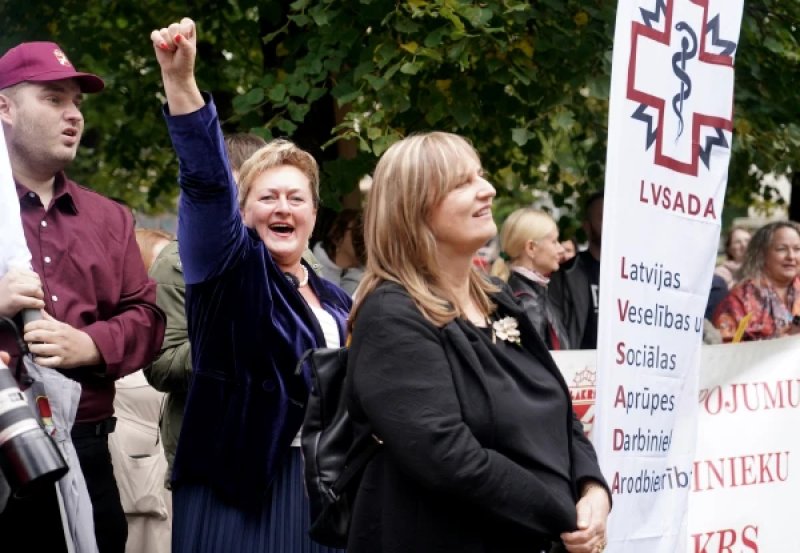
The picket was organized by the Latvian Trade Union of Health and Social Care Workers (LVSADA). Participants held placards with inscriptions such as "The government does not hear us," "Support for family doctors, health for patients," "Regions are not second-class, health for all," and "Before the elections — promises, after the elections — amnesia." There were also harsher slogans: "Healthcare without money — a patient without a pulse" and "Department closed — line straight." **They demand not promises, but money** The head of LVSADA, Liga Barinya, stated that the problems of Latvian healthcare have dragged on and the sector can no longer be satisfied with promises. According to her, medical workers are overloaded, patients have to wait in line, and hospitals are facing increasing difficulties in ensuring continuous operation. The union has repeatedly appealed to the responsible institutions. The authorities, as Barinya noted, acknowledge the existence of problems and speak of a constant dialogue, but now medical workers are waiting for concrete solutions backed by real funding. LVSADA's demand for the resignation of Health Minister Hosam Abu Meri was described by Barinya as a demand for political accountability. **Family doctors warn of staff shortages** The head of the Latvian Association of Family Doctors, Alise Nicmane-Aishpure, reminded of the promises that politicians made to healthcare before the elections to the 14th Saeima. She emphasized the importance of primary healthcare and noted that a family doctor cannot work effectively without a team and support staff. In addition, she called for increased funding for family doctors through capitation payments and criticized digital solutions in healthcare, particularly the cumbersome system of electronic referrals. A representative of the Latvian Association of Rural Family Doctors, Ainiss Dzalbs, pointed out the reduction in the number of family doctors and the aging of medical staff. In his opinion, to retain current workers and attract new ones, funding needs to be increased by 25–30%. **The minister was met with shouts of "Resign!"** During the picket, Health Minister Hosam Abu Meri came out to the protesters, followed later by Prime Minister Andris Kulbergs. The appearance of the politicians was met with discontented shouts from some participants. Abu Meri's speech was repeatedly interrupted by cries of "Resign!" The minister stated that he himself is part of the healthcare system and agrees that the health of the population is a matter of national security. At the same time, Abu Meri reminded about the significant funds that have been directed to the defense and security of the country in recent years. According to him, additional money for healthcare should be sought by several ministries together. The minister emphasized that it is impossible to simply find hundreds of millions of euros in the budget and promise them to the sector without having a real source of funding. It is also necessary to look for opportunities for savings. Barinya countered that saving on healthcare is not possible, as insufficient funding will result in worsening patient health and increased mortality. **The Prime Minister: money is needed, but it cannot be promised without coverage** Prime Minister Andris Kulbergs came out to the participants of the picket, interrupting a government meeting. He acknowledged the need for additional funding for healthcare, including salary increases for sector workers. However, the Prime Minister also stated that he does not intend to promise money for which there is no coverage in the budget. According to him, just the additional amount is not enough — systemic changes are needed to ensure that allocated funds reach medical workers directly. **Medical workers demand a salary increase of at least 30%** LVSADA demands that the state budget for 2027 include a salary increase for all healthcare workers of at least 30%. Initially, the union insisted on a 30% increase, but in search of a compromise, agreed to 25.4%. The Ministry of Health previously reported that a 25.4% salary increase would require €228.7 million. However, there is currently no specific decision on the allocation of these funds, nor is there a set deadline for when it should be made. If the government does not make specific and financially backed decisions, the union intends to convene an extraordinary council meeting and decide on further collective actions to protect the interests of healthcare workers.
