

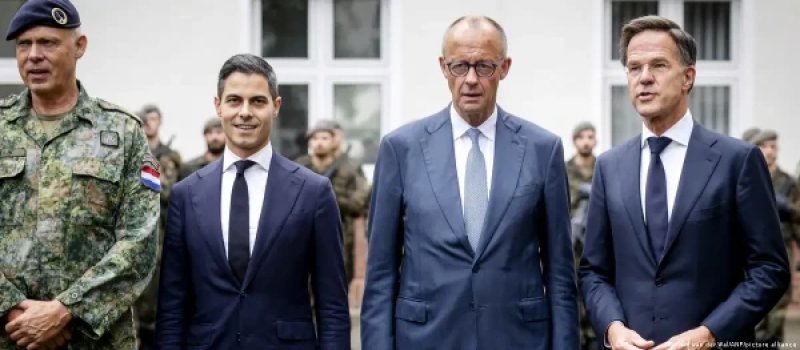
The International Westphalian Peace Prize 2026 has been awarded to NATO and the European youth movement socioMovens from Dortmund. The award ceremony took place on Thursday, October 1. Thus, "it pays tribute to an institution that, in an era of global uncertainty, provides reliability, fosters the development of partnerships, and makes the world possible through stability," explained Reinhard Zinkann, chairman of the Economic Society of Westphalia and Lippe, which presents the award. In turn, the socioMovens movement, based on the principle of "Giving Europe a Voice," organizes weeks of youth projects in Eastern European countries, the KNA agency clarified. They are held in Poland, Lithuania, Slovakia, Hungary, Croatia, and Romania. Previously, Ukraine was also among the project's partners, but due to the war, it has not been possible to implement new initiatives there so far. ## ## Rutte Does Not Currently See a Direct Military Threat to the Alliance At the award ceremony in the Münster Town Hall, German Chancellor Friedrich Merz delivered a speech. The award was accepted by NATO Secretary General Mark Rutte. He stated after the meeting with Merz that despite ongoing hybrid actions by Russia in Europe, he does not currently see a direct military threat to the alliance. However, allies must be prepared for the fact that "the campaign of hostile actions by Russia against allies continues," Rutte warned. In turn, the head of the German government criticized Russia's unwillingness to negotiate. "For almost five years, a 'murderous war unleashed by Moscow' has been raging in Ukraine," Friedrich Merz stated. According to him, the hostilities also threaten the security of the rest of Europe. "And that is why we are striving for a diplomatic solution, although Moscow is still not ready to sit at the negotiating table," the Chancellor added after visiting the German-Dutch Corps in Münster. ## ## Merz Warned of Russia's Attempts to Drive a Wedge into German Society At the award ceremony, Merz also warned of Russia's attempts to drive a wedge into German society. "In Germany, we will not allow ourselves to be divided," he emphasized. This concerns "hybrid attacks," "incitements on social media carried out by bots from Moscow," slogans from the right-populist "Alternative for Germany," and its Russian "patrons," the Chancellor pointed out. In the discussion about aid to Ukraine, accusations arise that it "is at the expense of the welfare of our own country," Merz noted. However, support for Ukraine "is not an end in itself," Merz is convinced. "We provide it primarily to protect the freedom and security of people in our country," he explained. If we fail to "stop Moscow, then sooner or later the Russian military machine will turn against us, against NATO itself," Merz warned. "We must not close our eyes to this danger," the head of the German government concluded. The monetary component of the prize for NATO is €100,000, while socioMovens received €50,000. ## ## Alternative Westphalian Peace Prize In connection with the criticism of the award to the North Atlantic Alliance, the Alternative Westphalian Peace Prize was also awarded by the cities of Münster and Osnabrück, the epd agency reported. In the Cathedral Square in Münster, the award was received by the international network of military service refusers Connection from Offenbach. The prize amounted to €10,000. The organization supports young people who do not wish to serve in the army. Additionally, it advocates for the recognition of refusal of service and desertion as grounds for granting asylum. ## ## Peace After the Thirty Years' War The International Westphalian Peace Prize was established in 1998 in memory of the Westphalian Peace Treaty signed in Münster and Osnabrück after the devastating Thirty Years' War. The award is presented every two years by the Economic Society of Westphalia and Lippe (WWL). It is the largest peace prize in Germany, awarded to individuals, organizations, or states that have made a significant contribution to European integration. Previously, the Westphalian Peace Prize has been awarded to, among others, the first president of the Czech Republic Václav Havel, former German chancellors Helmut Kohl and Helmut Schmidt, former French president Valéry Giscard d'Estaing, former UN Secretary-General Kofi Annan, the ISS crew, King Abdullah II of Jordan, as well as the three Baltic states - Estonia, Latvia, and Lithuania.
