

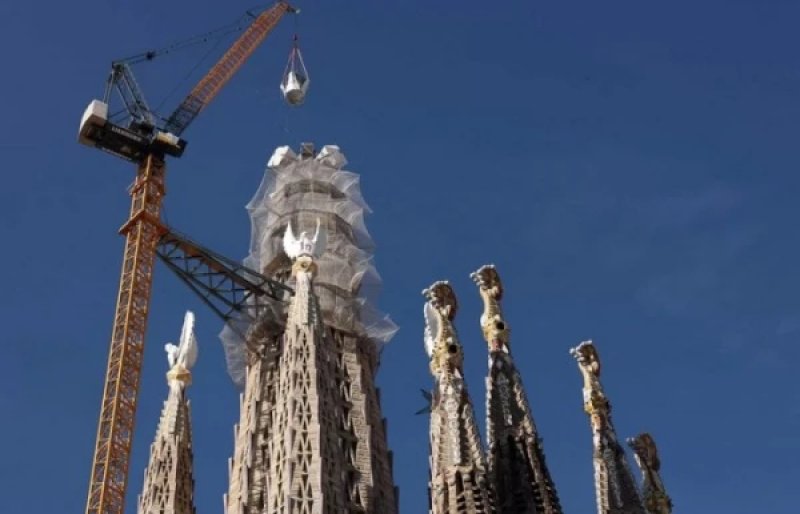
In the construction of the central towers of the Sagrada Familia, engineers had to find solutions to several complex challenges. The structures must withstand their enormous weight, strong gusts of wind, and constant vibrations from the bustling city. One of the key elements of modern constructions has become tens of tons of special high-strength glue. It is used to connect massive blocks of natural stone with hidden metal elements inside. ## Stone on the Outside, Modern Technology on the Inside This solution allows for the preservation of the building's appearance as close as possible to Gaudí's architectural concept while simultaneously ensuring the necessary strength of the towers. Modern adhesive joints are designed for extremely high loads. This is especially important for the central tower of Jesus Christ and the surrounding spires, which must withstand not only wind but also vibrations caused by intense urban traffic. Another issue is related to Barcelona's location by the Mediterranean Sea. High humidity and sea air increase the risk of corrosion of metal elements. The polymer compounds used seal the joints and thus provide additional protection for the internal structure. ## Gaudí Meets the 21st Century As a result, builders have effectively combined two completely different approaches. On the outside, the Sagrada Familia remains a monumental stone temple envisioned by Gaudí in the 19th century, while inside its largest elements, modern steel, engineering calculations, and polymer materials are used. It is these new technologies that have allowed the continuation of the construction of these extremely complex towers without abandoning the original architectural idea. Thus, nearly a century and a half after the start of construction, one of the most famous long-term construction projects in the world is simultaneously becoming a monument to Gaudí and a demonstration of modern engineering capabilities. The stone here retains its 19th-century appearance, while 21st-century technologies help support the grand structure.
