

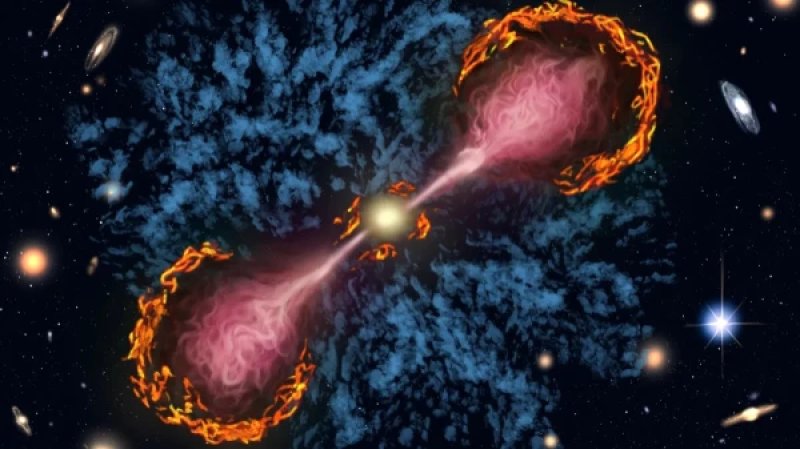
An international group of scientists has discovered how supermassive black holes can stop the formation of new stars in their galaxies. The study helps explain one of the main mysteries of modern astrophysics — why many galaxies gradually cease to create new stars over time. Large galaxies, including the Milky Way, are surrounded by vast reserves of gas and dust — the so-called circumgalactic medium. This material serves as the 'building material' for the emergence of new stars. Until now, scientists have been unable to definitively explain why this gas stops cooling and condensing over time to the extent that new celestial bodies can form from it. The new study shows that supermassive black holes located at the centers of galaxies play a key role in this process. During the absorption of matter, they emit powerful plasma jets — narrow streams of high-energy particles that extend far beyond the central part of the galaxy. Researchers found that these jets collide with the surrounding gas, heating it and disrupting its structure. As a result, the gas loses its ability to cool effectively and transform into material for the birth of new stars. "This is a groundbreaking result that helps solve the long-standing mystery of how black holes affect galaxies, their stars, and life as we know it," said one of the study leaders, Sanchayita Bortakur from Arizona State University. Scientists find the scale of this impact particularly surprising. Despite their colossal mass, supermassive black holes are insignificant in size compared to galaxies containing hundreds of billions of stars. "How can something so small exert such a huge energetic impact?" noted co-author Namrata Roy from the Raman Institute. For their work, the scientists used data from the Dark Energy Spectroscopic Instrument (DESI) project, which observes hundreds of galaxies, as well as results from the LOFAR Two-meter Sky Survey (LoTSS). Observations showed that the jets have the most powerful impact not at the center of the galaxy, but at its outer edges, where they first collide with the surrounding circumgalactic medium. It is there that the maximum amount of energy is released. The researchers detected a characteristic glow of ionized gas along the trajectory of the jets, which served as direct evidence of their interaction with the surrounding material. According to the authors of the study, this process gradually depletes galaxies of the cold gas necessary for forming new stars. As a result, star formation slows down and then virtually ceases. "The black hole is incredibly small compared to the galaxy, but its influence extends hundreds of thousands of light-years, reaching the farthest outskirts," emphasized Namrata Roy. The authors believe that the results open new opportunities for studying how supermassive black holes determine the evolution of galaxies over billions of years. The study is published in the scientific journal [Astrophysical Journal Letters](https://iopscience.iop.org/article/10.3847/2041-8213/ae9cbd).
