

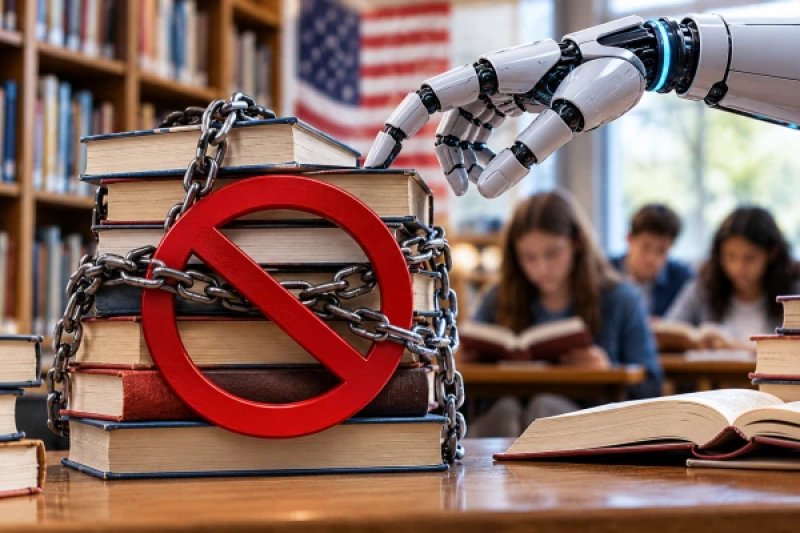
As [reported](https://nos.nl/artikel/2633813-scholen-vs-verbieden-recordaantal-van-12-000-boeken-en-ai-hielp-daarbij) by the Dutch broadcaster NOS, citing a study by the human rights organization PEN America, this is the highest number since 2021, when the organization began tracking such statistics. PEN considers the current situation a sign of the further escalation of the issue of book restrictions in American schools. ### Books on Race and LGBT Under Ban In several American states, strict rules are in place regarding which topics are allowed to be discussed and taught in schools. As a result, works addressing issues of race and LGBT are being removed from school libraries. The most bans have been recorded in Texas and Florida, where the majority belongs to the Republican Party. According to PEN America, these states have become the most prominent examples of restrictions on access to literature in the education system. As before, restrictions most often affect Young Adult literature — books for teenagers and young adults. Primarily, this concerns fictional works. ### AI Triggers a "Snowball Effect" The authors of the study pay special attention to a new trend: school districts are increasingly using artificial intelligence to determine whether access to a particular book should be restricted. According to PEN America, a kind of vicious circle arises. AI takes into account information about which works have already been banned in other schools, and this can influence subsequent decisions. As a result, the content of a specific book, the organization claims, sometimes no longer becomes the main subject of evaluation. PEN refers to this mechanism as the "snowball effect": previous bans can become the basis for new ones. ### Stephen King — Record Holder The most restrictions have affected the works of Stephen King — PEN counted 312 instances of his books being banned. Among the works that have been particularly frequently restricted over the past year are "The Handmaid's Tale" by Margaret Atwood, "The Kite Runner" by Khaled Hosseini, and "Looking for Alaska" by John Green. For several years, "The Diary of Anne Frank" has also appeared on the lists of banned works — the complaints are related to fragments in the book concerning sexuality. Restrictions have also affected graphic novels and the increasingly popular Japanese manga in the US. PEN notes that individual images can be evaluated out of context, and in some cases, not just one book but an entire series may be banned. According to PEN America, such practices limit the freedom to read and deprive students of the opportunity to engage with various perspectives, voices, and literary works. And now the debate over banned books in the US takes on a new dimension: decisions that were previously made by people after studying the works are increasingly being assisted by algorithms — and the previous ban of one book can become an argument for the next.
