

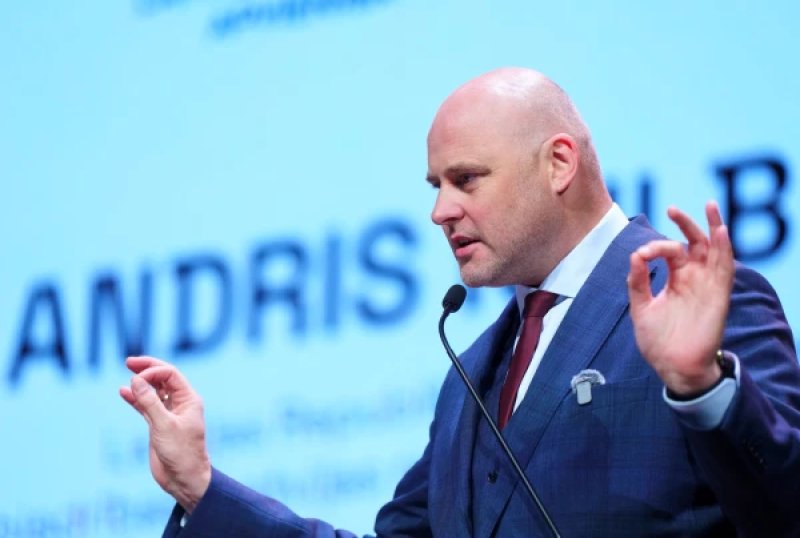
 Foto: BB.LV / Андрис Кулбергс
This morning, the head of the government reacted to the report that a 300 percent tariff on the transit of Russian grain through Latvia has still not been introduced. Here is what was said in the released statement for the media: "Prime Minister Andris Kulbergs suggests considering the liquidation of the subsidiary of the State Joint Stock Company 'Latvijas dzelzceļš' LatRailNet, transferring the functions of determining the railway infrastructure fee to the Public Utilities Commission (PUC). 'LatRailNet' must demand a specific, legally justified decision, rather than just listing obstacles; at the same time, Latvia must promote joint actions of the Baltic states and the EU. Therefore, the Prime Minister instructed the ministers to prepare specific legal solutions for suspending the transit of grain of Russian and Belarusian origin. LatRailNet, in the assessment presented to the government, points out the legal and economic limitations of establishing an infrastructure fee. The Prime Minister expects these considerations to be supplemented with verifiable calculations regarding the effectiveness of the chosen solution and clearly named issues for which a decision from the government or the European Union is necessary. "The government's goal is clearly defined — to stop the transit of grain from aggressor countries. We expect a specific, legally justified decision from LatRailNet. If the chosen tool does not allow us to achieve the goal, another must be proposed. Legal risks must be assessed, but a mere list of obstacles is not enough. I expect a specific proposal from LatRailNet within the competence of the enterprise, detailing what can be done, within what timeframe, and with what result. If the political goal cannot be achieved with the infrastructure fee, this must be clearly stated and justified, so that the government can make decisions on other tools," said A. Kulbergs. The Prime Minister noted that it is necessary to review the institutional model for establishing the infrastructure fee, assessing whether a separate structure within the 'Latvijas dzelzceļš' concern provides the necessary independence and efficiency. In September, Latvia promoted a special regime for the railway infrastructure fee to make the transit of Russian grain economically unprofitable. On September 17, the Saeima adopted amendments to the Railway Law, expediting the review and introduction of the infrastructure fee. LatRailNet was called upon to assess the possibility of increasing the fee to three times the previous amount. "The legal arguments presented by the company must be carefully evaluated. But if we cannot achieve the set goal with the infrastructure fee, the ministers must present another legal solution. If amendments to the law are necessary, they must be promoted. If national sanctions are needed, they must be prepared. The government's responsibility is to achieve results," noted Kulbergs. Europe must agree on a joint approach The Prime Minister emphasizes that restrictions must be coordinated at the level of the Baltic states and the European Union so that the cargo from aggressor countries cannot bypass them by redirecting to the railways and ports of neighboring countries. "The Baltic states must act in unison, and Europe must agree on a joint solution. Our goal is to stop this transit, preventing it from moving from one country to another," emphasizes Kulbergs. Kulbergs highlights that the Estonian government's decision to ban the transit of grain of Russian and Belarusian origin is an important step in the overall security policy of the Baltics. It should be noted that, according to the Estonian Ministry of Foreign Affairs, the transit of Russian grain through Estonia has been almost nonexistent until now. Therefore, the ban has a primarily preventive purpose, aimed at preventing the creation of a new export route for Russian grain. The Prime Minister intends to discuss this issue with European Commission President Ursula von der Leyen next week in Brussels. Latvia's goal is to achieve a coordinated, legally sound, and practically effective solution. Kulbergs has instructed the ministers of foreign affairs, justice, and transport to assess the application of Estonia's decision in Latvia, including its impact on the national economy and potential risks of international litigation. Transport Minister Richard Kozlovskis has been tasked with preparing a draft law for the liquidation of LatRailNet and the transfer of its functions to the PUC. The proposal must evaluate the legal and practical conditions for taking over functions while ensuring compliance with European Union requirements and continuity in establishing the infrastructure fee. The transport minister must also assess Poland's approach to limiting the transit of Russian grain, including the separation of transit and import under different conditions of cargo transshipment and storage. The assessment must determine whether and how such an approach can be legally applied in Latvia. Foreign Minister Baiba Broka must present a proposal to the Cabinet of Ministers within a week for banning transit, based on Estonia's approach, and assess its impact on budget revenues. Together with Justice Minister Edward Smilten, a package of national sanctions to ban the transit of grain of Russian and Belarusian origin must be prepared, evaluating its financial impact and compliance with European Union laws. Agriculture Minister Uldis Augulis must report next week on the progress of grain sampling and the results of cooperation with Ukraine.
