

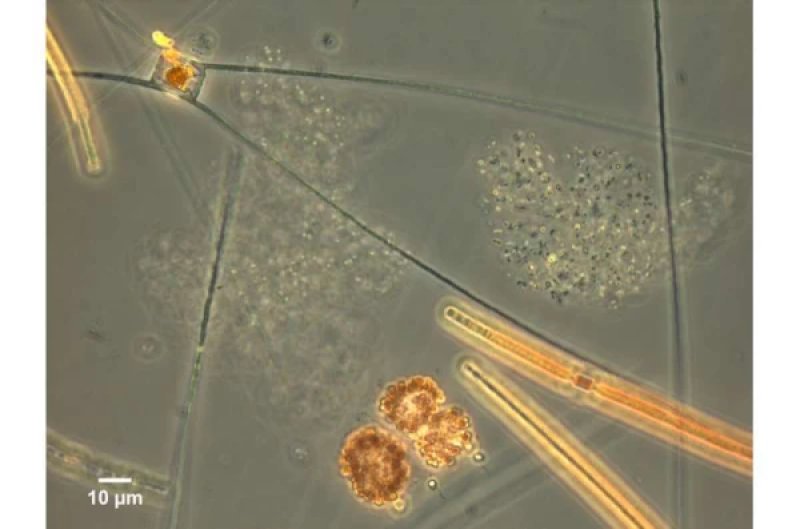
Researchers from Stockholm University have discovered that picocyanobacteria—some of the smallest and most numerous photosynthetic organisms in the Baltic Sea—are capable of effectively transporting carbon from the upper layers of water to the depths. The results of the study were published in the scientific journal [The ISME Journal](https://academic.oup.com/ismej/article/20/1/wrag214/8772006). Phytoplankton plays a key role in the global carbon cycle by absorbing carbon dioxide (CO₂) during photosynthesis. According to scientists, phytoplankton accounts for about half of all photosynthesis on Earth. When its biomass settles to the bottom, the associated carbon is removed from the atmosphere and surface waters. This mechanism is referred to as the biological pump. It helps regulate the concentration of CO₂ in the atmosphere, but it also affects the state of marine ecosystems. The decomposition of settled organic matter, for example, contributes to the formation of hypoxic zones in the Baltic Sea. The researchers paid special attention to picocyanobacteria of the genus *Synechococcus*. Their cell size does not exceed two micrometers, which is why it was long believed that they are virtually incapable of settling to depth on their own. However, the study showed that some strains of these microorganisms form colonies and larger aggregates. As a result, they begin to settle significantly faster and transport the associated biomass to the deeper layers of the sea. "We have shown that the ability of different strains of picocyanobacteria to form aggregates directly determines what portion of their biomass is transported to depth. This is particularly important as in a warmer and nutrient-poor ocean, the abundance of picophytoplankton is expected to increase," noted the lead author of the study, Martin Ekman. The research was conducted in the Landsort Deep area of the Baltic Sea. In spring and summer, the scientists collected water samples at various depths, used sediment traps, and then combined microscopy, flow cytometry, and genetic sequencing to trace which microorganisms reach the deep layers. It turned out that not all strains behave the same way. Some predominantly exist as individual cells, while others much more frequently form colonies and therefore participate more effectively in carbon transport. The researchers also found seasonal differences among such strains. This suggests that the ability to aggregate may be an important ecological feature influencing how different microorganisms will respond to climate change. According to the scientists, the results obtained will help to more accurately predict changes in the global carbon cycle as the climate warms. The next step will be to study similar processes not only in the Baltic Sea but also in other areas of the World Ocean. "Long-term monitoring data have become an invaluable resource for our work. Now we plan to investigate similar processes in other parts of the World Ocean," said co-author of the study, Professor of Microbial Oceanography at Stockholm University, Rachel Foster.
