

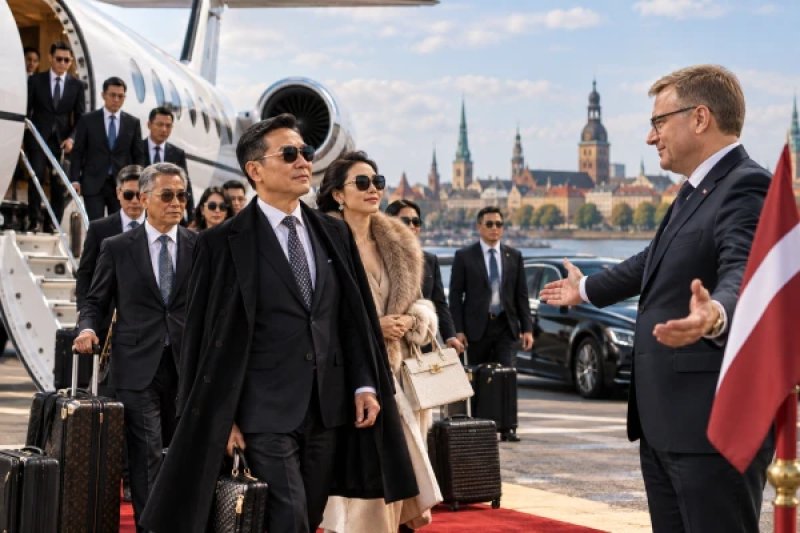
 Foto: BB.LV / Богатые китайцы прибывают в Ригу
While Kulbergs is preparing the declaration of the future government and determining the composition of the cabinet, news has come from Switzerland that may be quite timely. On October 8, the authoritative Swiss newspaper Neue Zürcher Zeitung (NZZ) published an article titled "All the cash is gone: hunting the rich is now allowed in China." According to the publication, there are more than 500 billionaires in China, and the number of millionaires is measured in many thousands. However, now the Chinese authorities are increasingly trying to seize their fortunes, while the wealthy are looking for ways to hide their money abroad. ## ## Chinese Exports: Success or Costly Bluff? The Swiss are primarily interested in what is happening in China from the perspective of capital preservation. The Germans are concerned about something else: Chinese cars are displacing German ones not only in China but also in the German market. However, behind the external successes of Chinese exports, the author believes, serious financial problems are hidden. As of September 8, Neatkarīgā summarized the German version of what is happening: the low prices of Chinese cars, which allow them to compete with Volkswagen and other European manufacturers, are not just dumping but a costly strategy that Beijing will not be able to sustain indefinitely. The more China exports products at artificially low prices, the more money is needed to maintain this model. In fact, the profits from exporting some goods have to be directed to cover losses from selling others, primarily electric vehicles. Moreover, subsidies can take non-obvious forms. For example, Chinese automakers are reportedly allowed to delay payments to suppliers of components and services for almost a year, or even longer. Some companies manage to go bankrupt during this time, leaving suppliers unpaid. The resulting social problems ultimately have to be addressed by the state. According to the author, this system could exist as long as China was making enough profits from other export sectors. However, the COVID-19 pandemic and Donald Trump's trade wars, which began during his first presidential term in 2017, undermined the previous model. Real income from exports began to decline, and maintaining its volume increasingly depended on borrowed funds. It is no coincidence that NZZ concludes its publication with a reminder: China's total debt exceeds 300% of the size of its economy. ## ## Chinese Millionaires Seek Refuge in Europe Debt pyramids cannot be built indefinitely. Sooner or later, both the debts themselves and the fortunes, which exist mainly in the form of obligations that can no longer be fulfilled, have to be written off. In China, this process is accompanied by a struggle for social justice, under the slogans of which the authorities are seizing wealth from entrepreneurs. NZZ begins its article with the story of an unnamed Chinese multimillionaire. According to him, local authorities regularly come to him with demands for money. Sometimes it involves large sums, sometimes relatively small amounts. Each time, officials refer to alleged violations, although, as the entrepreneur claims, neither the violations nor the relevant rules often exist. Now the 54-year-old businessman intends to transfer his fortune to Europe to protect it from confiscation and later pass it on to his children. NZZ links the current problems to the crisis in the Chinese real estate market. One of the main victims has been local authorities, whose budgets have depended on selling land to developers for many years. Now developers are not buying new plots and are trying to get rid of unfinished projects. In search of money, municipalities resort to various methods. In addition to pressuring wealthy entrepreneurs, the publication describes cases where trucks are sent to weigh stations with improperly calibrated scales, after which drivers are fined for non-existent overloads. But even these revenues are not enough. In many municipalities, debts for salaries to officials, teachers, and public transport drivers are accumulating. ## ## Money of Chinese Rich and International Information Exchange The central authorities of China are using different methods. One of the most important tools is the international automatic exchange of financial information system CRS (Common Reporting Standard). Latvia has been participating in it since 2016. In 2023, the Ministry of Finance explained to the members of the Saeima that thanks to this system, Latvia receives information about the accounts of its tax residents abroad from about 100 countries. In return, it provides information about the accounts of foreign residents in Latvian banks. At that time, the then Deputy Director General of the State Revenue Service for Tax Issues, Daiga Peleka, reported that the initial exchange was accompanied by technical difficulties. Countries had to agree on different ways of identifying individuals and legal entities. Over time, the system began to operate normally and allowed for the identification of foreign income of Latvian taxpayers. According to the NZZ publication, China is also using this mechanism to search for the assets of wealthy citizens abroad. This could involve the recovery of amounts measured in billions of dollars or euros. However, even such money is not enough to cover the accumulated state and private debts. But if at least a small part of the capital of Chinese billionaires could be attracted to Latvia, the author speculates, the country could gain entirely new sources of income. ## ## Will Kulbergs Turn Latvia into a Tax Haven? The idea of attracting foreign millionaires and billionaires to Latvia is not new. On February 24, Neatkarīgā reported on a discussion organized by the Bank of Latvia in the run-up to the parliamentary elections. Representatives of the leading political forces were asked to explain how they plan to curb the growth of public debt if they come to power. Andris Kulbergs then stated that one of the solutions could be attracting the wealthiest people in the world, to whom Latvia would offer special, reduced tax rates. According to him, he and like-minded individuals were already preparing the relevant legislative amendments. On March 11, Neatkarīgā provided more details about Kulbergs' plans to make Latvia a "tax haven for decent foreign wealthy individuals." However, this idea has its critics. The head of the monetary policy department of the Bank of Latvia, Uldis Rutkaste, acknowledged that tax havens can indeed attract companies. But at the same time, he warned: countries where these companies were established and developed are increasingly opposing such schemes. Therefore, according to Rutkaste, the prospects for such business are quite dubious. In March, no one knew how the political situation in Latvia would change. Now, however, Andris Kulbergs has become the Prime Minister and received significant trust to form a government and implement his policies. The question remains: will the influx of foreign billionaires and their capital be an additional advantage for Latvia or, on the contrary, undermine trust in the new government? Especially since international rules — both written and unwritten — are changing almost daily today. And it is still difficult to predict what tax experiments Latvia will be able to afford and how other countries will react to them.
