

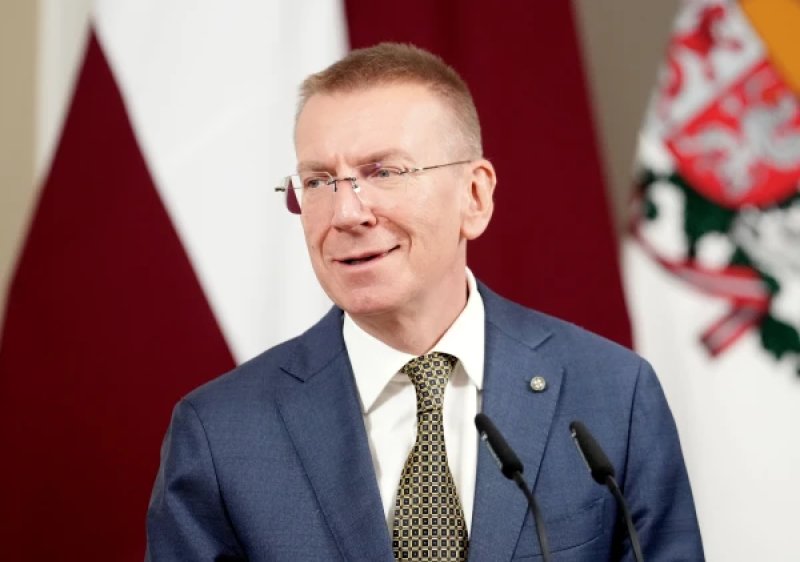
 Foto: BB.LV / Эдгар Ринкевич
Russia is not yet demonstrating readiness to end the war against Ukraine, and statements by U.S. President Donald Trump about possible agreements with Moscow do not provide grounds for expecting a quick ceasefire. This opinion was expressed by Latvian President Edgars Rinkevics. In an interview with the TV3 program "900 seconds," reported by LETA, the head of state emphasized that he assesses the prospects for a peaceful settlement realistically. > “Putin is still convinced that he can win,” Rinkevics said, explaining why, in his opinion, the Russian leadership is not eager to end the war. At the same time, the President of Latvia would positively evaluate a real agreement to cease attacks on energy infrastructure. > “If the United States can indeed achieve a so-called energy ceasefire, it would benefit everyone,” he noted. However, Rinkevics urged against drawing far-reaching conclusions from the recent statements from Washington. In his observations, international politics over the past year and a half has been characterized by "more or less controlled unpredictability." The rhetoric of the American administration has repeatedly changed regarding both the war in Ukraine and the crisis in the Middle East. An additional factor, the president noted, is the upcoming elections in the United States and high fuel prices, which affect the domestic political agenda. Commenting on the agreement announced by Trump regarding the supply of Russian diesel fuel, Rinkevics did not interpret it as unequivocal evidence of rapprochement between Washington and Moscow. He reminded that the U.S. continues to maintain official and unofficial contacts with Russia. Throughout the war, various negotiation initiatives have received positive assessments, including meetings of American presidents with the leaders of Ukraine and Russia. In particular, Rinkevics mentioned the U.S.-Russia summit in Anchorage in August 2025 and the peace plans discussed last winter. However, none of these initiatives led to a cessation of hostilities. Therefore, the president believes that European countries need to focus on solutions that depend directly on them. > “There are things we can influence. There are things we cannot influence. But there are also things we can influence in the European context,” he said. Rinkevics identified the main task as continuing military and financial support for Ukraine regardless of changes in American policy. According to him, assistance is especially needed now, as Russian strikes continue, and a harsh winter may lie ahead. The president also noted the development of military technologies. In particular, Russia is using drone strikes, the interception of which presents additional challenges. At the same time, he characterized the actions of Ukrainian forces as inventive, mentioning strikes on Russian oil refineries and data centers. A separate concern for Rinkevics is the political situation in Europe itself. In his assessment, the next year could be particularly important for maintaining European support for Kyiv. In several Western European countries, political forces are advocating for a reduction in aid to Ukraine or the restoration of economic ties with Russia. The president mentioned calls in Germany to resume energy cooperation with Moscow, as well as demands from certain political forces in France to stop financial support for Ukraine. For now, he considers discussions about the return of Russian gas to the European market to be predominantly theoretical. However, upcoming elections in European countries could influence further decisions by the European Union. That is why, Rinkevics emphasized, Ukraine needs to receive as much assistance as possible right now so that it can survive the winter. The head of state acknowledged that coordinating support for Kyiv among European partners is becoming increasingly difficult. He described the spring of 2022, immediately after the start of the full-scale Russian invasion, as the simplest period for decision-making. Subsequently, reaching compromises has become more challenging, although a general line of support has been maintained. One unresolved issue remains the use of frozen Russian assets to assist Ukraine. > “Here we have hit a dead end,” the president acknowledged, noting that unanimity on this issue has not been achieved. According to him, difficulties have also arisen in extending certain sanctions against Russia. Against this backdrop, additional questions arise regarding the U.S. decision to temporarily allow the supply of Russian diesel fuel to global markets until April 2027. American authorities explain such relaxations as necessary to alleviate the situation with shortages and high fuel prices. However, the easing of restrictions raises concerns, as oil revenues remain one of the sources of funding for the Russian war. Ukrainian President Volodymyr Zelensky criticized Washington's decision on Friday, calling it "undignified" and "weak." His statement came amid preparations by the Ukrainian delegation for negotiations with American representatives. Rinkevics, for his part, believes that European support for Ukraine should not depend on such fluctuations in international politics. As long as there are no signs of Russia's readiness to end the war, the priority for Europe should remain assistance to Kyiv and strengthening its ability to withstand Russian attacks.
