

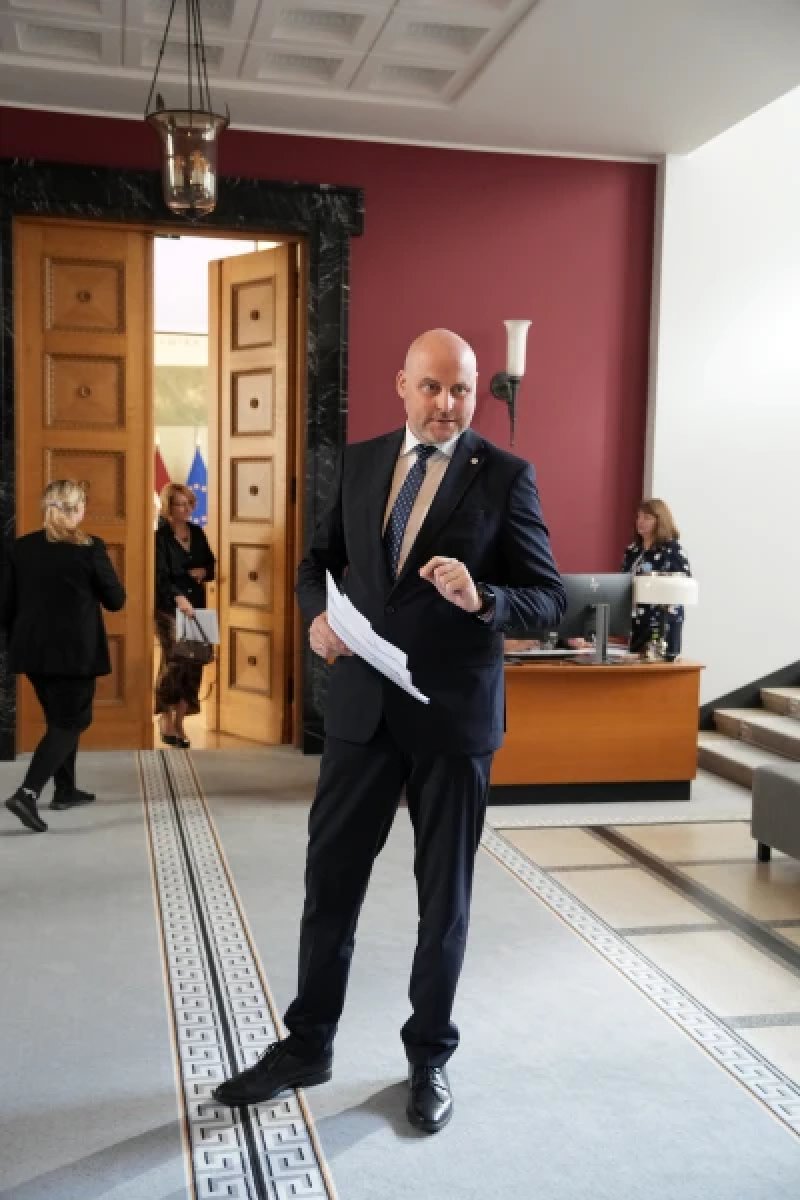
Currently, the most popular politician in Latvia has to split his attention "on three fronts" – leading the still-functioning "old" government, preparing for a trip to Brussels for a European Council meeting (the highest decision-making body in the EU, consisting of the prime ministers of EU countries), and writing the declaration of the future government. ## 5 Percent and No Less! It should be noted that the first meeting of the new Saeima will take place only on November 3, and only then will the current government de jure resign, and the president will be able to officially assign Andris Kulbergs (United List) to form a new government. According to rumors, unofficial negotiations to create a new government may begin at the end of next week – by that time, the draft declaration will already be ready! Again, according to unofficial information from the corridors of power, the declaration will consist of three sections. The first is security. In it, coalition partners will commit to maintaining defense funding at 5% of GDP, as well as continuing to provide consistent assistance to Ukraine. Additionally, the declaration will promise to complete the construction of all necessary infrastructure on the eastern border, including the creation of all necessary response mechanisms (sensors, detectors, video cameras, etc.) to attempts to breach the border, the establishment of a counter-mobility system, and so on. ## Hands Off the Convention Apparently, the declaration will include a commitment from the parties not to bring political initiatives that divide society to the Cabinet of Ministers and the Saeima. It cannot be ruled out that Kulbergs will ask potential partners to promise him to "leave alone" the issue of the Istanbul Convention. Recall that at the end of last year, the Saeima approved a law to withdraw from this convention; however, the president returned the document to parliament with a proposal not to consider this law in the current convocation of parliament. It is likely that now the partners will agree not to return to this law in the new Saeima. Immediately after the elections, however, Kulbergs hinted at the need to hold some kind of consultative referendum on this issue, but, according to rumors, his party colleagues explained to him that, firstly, such a consultative referendum is not stipulated in either the Constitution or the laws, secondly, this referendum, in any case, will not have legal force, meaning it will not be mandatory and will be akin to a simple opinion poll, and thirdly, the Constitution prohibits holding referendums on international treaties (agreements, conventions, etc.). ## Fewer Councils and Directives The second section may include all proposals for reforming the public administration system. This includes possible mergers of ministries and reforming the management system of state capital companies (state enterprises) – in particular, the councils of several state enterprises may be reduced, the salaries of the management of state enterprises will be linked to the financial indicators of those very state enterprises, and the merging of several state enterprises cannot be ruled out. In particular, the prime minister and the finance minister are extremely dissatisfied that several state structures still manage real estate issues, although it has long been decided to hand over all "real estate" to the management of "Valsts nekustamie īpašumi" (State Real Estate Agency). If we are talking about ministries, then the Ministry of Climate and Energy may be the first to be liquidated, with its functions planned to be distributed between the Ministry of Economics and the Ministry of Smart Administration and Regional Development. However, the reduction (liquidation) of ministries may not lead to any significant savings if the ministry employees are simply "scattered" across other ministries and agencies. They also need workplaces and salaries... ## What About Taxes? The third section of the declaration will be dedicated to budgetary issues and priorities. Kulbergs plans to include in the document a commitment to reduce public spending, primarily in the area of public procurement. Even before the elections, Kulbergs and Co. dreamed of introducing the principle of "zero-based budgets" for ministries, meaning that all previous expenses are "forgotten" and ministries start anew, from scratch, to draft their budgets, trying to minimize the expenditure part. It is clear that this principle will not be included in the declaration – firstly, because it is impossible to implement this principle in the 2027 budget in time, and secondly, it does not guarantee a reduction in expenses. Recently, Finance Minister Maris Kucinskis again assured that at least next year, no tax increases are planned – the ruling party will try to manage with a reduction in administrative expenses and a partial revision of tax benefits for certain groups of the population. Although the cancellation of benefits is also an indirect tax increase. It is clear that no easy solutions can be expected – the economy is growing at a very slow pace, unable to keep up with inflation and state treasury expenses. It is also impossible to endlessly accumulate debts, as ultimately the state will simply be unable to cope with payments under debt servicing. Certain hopes in terms of increasing revenues are placed by Kulbergs on the Development Fund, which still exists only in the dreams of the prime minister himself. In his vision, the Fund should finance promising state projects that will then generate real profits. For example, the Fund could also invest the funds of the second pension level, as well as contributions from foreign investors under the residence permit program in exchange for investments. Recall that in the new Immigration Law, an amendment by Kulbergs was approved allowing citizens of countries friendly to Latvia to obtain residence permits if they invest funds in a special Fund. ## Not Signing is Dangerous One way or another, the declaration, according to Kulbergs, will contain many unpopular decisions. However, it is hard to imagine that any potential partners would refuse to sign it – after all, in this case, the party risks remaining in opposition. For example, in "New Unity," they understand perfectly well that if this party remains in opposition, the new authorities will remember everything that the Silinš – Ašeradens party did and did not do during the 17 years that this political force was in power in the country!
