

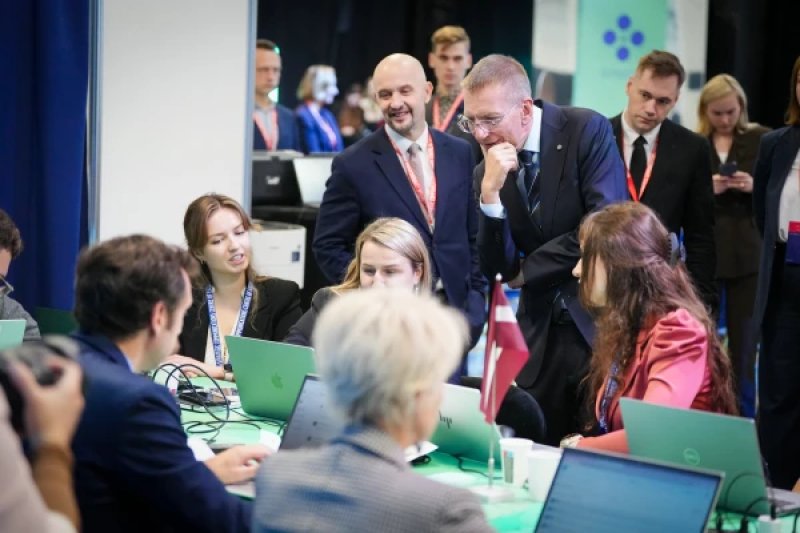
 Foto: BB.LV / Президент Латвии посетил учения Synesis 2026
On Tuesday, October 13, the President of Latvia visited the Synesis 2026 exercises organized by the NATO Strategic Communications Centre of Excellence (NATO StratCom COE). The head of state was presented with the strategic context, scenario, and main objectives of the exercises. Rinkēvičs also familiarized himself with the technologies used and observed the interaction of teams from 13 countries in a specially modeled information environment. ### Artificial Intelligence Becomes a New Threat Factor The President emphasized that the growing role of artificial intelligence in the modern information environment requires new approaches to ensuring security. According to him, during the exercises, it is necessary to test how information influence can affect various population groups and what behavioral patterns it can provoke. "One of the components of hybrid threats is indeed disinformation and manipulation in the information environment. It is important that the experience gained during the exercises allows for improving the ability of states to respond in the information space, thereby strengthening readiness for crisis situations," Rinkēvičs stated. ### Teams from 13 Countries Practice Actions in Hybrid War Conditions The Synesis 2026 exercises are taking place in Riga this week and bring together civilian and military specialists from different countries. According to the organizers, this is the first of its kind intersectoral civil-military NATO exercise on strategic communications, utilizing innovative solutions based on artificial intelligence. Participants are working in a simulated information environment, where they can test various crisis scenarios, assess the consequences of information impacts, and practice joint actions. The main goal is to enhance the ability of states to respond promptly to threats in the information space and manage crisis situations in hybrid war conditions. For Latvia, located on NATO's eastern flank, such exercises are particularly significant, as information operations and disinformation are seen as one of the components of modern security threats.
