

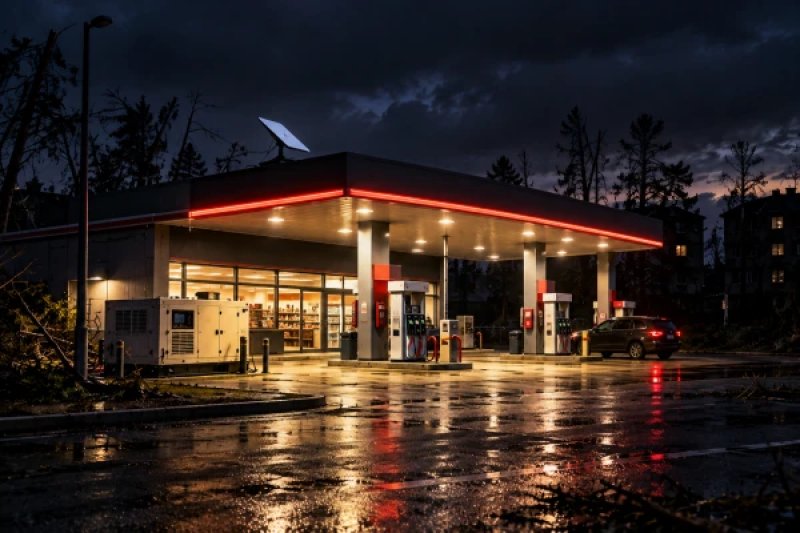
 Foto: BB.LV / Ночная заправка после грозы
Equipping all gas stations in Latvia with generators and satellite internet could cost businesses significant amounts. Representatives of the fuel industry believe that the new requirements should be accompanied by state co-financing, and it is impractical to apply them without exception to all gas stations, LETA reports. According to market participants, the cost of a stationary generator, depending on the required power, ranges from 15,000 to 30,000 euros. Additionally, there will be costs for equipment installation, satellite internet connection, maintenance, and regular inspections. For large networks, such expenses mean substantial investments, while for small regional gas stations, they can become particularly serious financial burdens. Therefore, industry representatives propose a different approach: to identify strategically important gas stations in each region that should continue to operate even during large-scale power and communication outages. When selecting such stations, it is suggested to consider their geographical location, importance for providing fuel to the population, and the availability of other gas stations nearby. The industry also emphasizes the need to improve the reliability of the power grids and mobile communications themselves. According to fuel traders, the state should work with infrastructure operators to ensure their resilience to emergencies, rather than shifting all responsibility onto gas station owners. At the same time, some gas stations already have backup generators and the ability to connect to satellite internet. Other businesses are purchasing mobile generators, testing satellite communications, and battery systems capable of maintaining equipment operation during short power outages. What does this mean for motorists? In the event of a large-scale power outage, equipped gas stations will be able to continue selling fuel. Additionally, satellite internet should allow residents to receive information and contact loved ones if regular mobile communication becomes unavailable. On October 12, the initiative to require all gas stations to have autonomous power sources and satellite communication was supported by the ruling coalition parties. The impetus was the consequences of a severe storm that hit Latvia on August 22 and the following night. Wind gusts exceeded 30 meters per second in some areas, damaging power grids, and gas stations, stores, and communication means ceased to operate in certain regions. Authorities hope that the presence of generators and satellite internet will allow gas stations to perform an important function during such emergencies — providing residents with fuel and access to information. Relevant amendments are planned to be made to the Energy Law. They are yet to be considered by the Saeima. Representatives of the fuel industry insist that before introducing new obligations, it is necessary to define technical requirements, provide a sufficient transition period, and address the issue of state co-financing. While a final decision has not been made, the main question remains open: will all gas stations be required to install expensive equipment, or will the increased requirements only apply to strategically important stations.
