

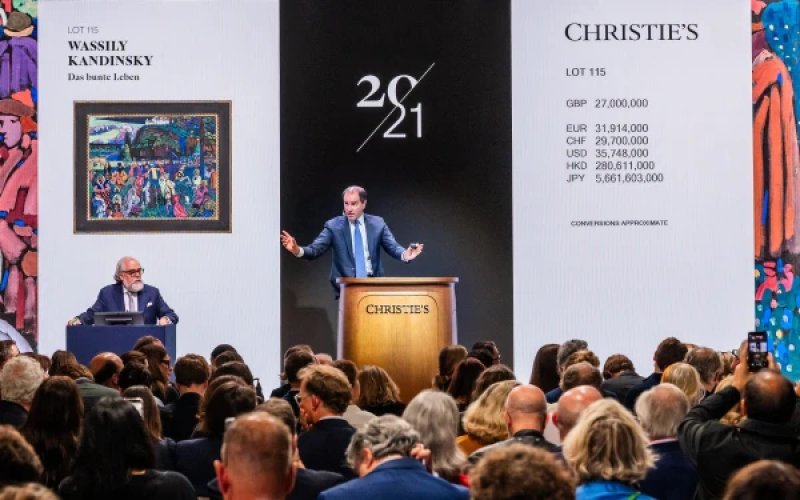
 Foto: BB.LV / аукцион
At a Christie's auction in London, Wassily Kandinsky's painting "Colorful Life" (Das bunte Leben), created in 1907, was sold. The final auction price amounted to 27 million pounds sterling, exceeding the upper limit of the auction house's preliminary estimate. According to DW, citing data from Christie's, before the auction began, the value of the canvas was estimated at 18–25 million pounds. Taking into account taxes and additional fees, the new owner will pay 31.56 million pounds sterling, reports the DPA agency. "This is a revolutionary work that reflects the development of the painter's artistic language and marks an astonishing transformation of his style in the following years," noted a representative of Christie's before the auction. Kandinsky created "Colorful Life" in Paris in 1907. The canvas belongs to the early period of his work, when the artist gradually moved away from traditional figurative painting and moved towards abstractionism, of which he later became one of the founders. However, the value of the painting is not only related to its place in art history. Over more than a century, the canvas changed several owners, survived Nazi confiscations, and became the subject of a long-standing dispute over the return of cultural property. In 1927, "Colorful Life" was acquired by the Levenstein couple, collectors from Amsterdam. Later, they transferred the work for temporary storage to the city museum. After the occupation of the Netherlands by Nazi Germany, the painting was seized from the museum. In October 1940, it was sold at auction, and it left the family's possession. Several decades later, in 1972, the canvas was purchased by the German bank Bayerische Landesbank. Subsequently, the painting was on long-term loan to a museum in Munich. The heirs of the previous owners sought the return of the family property for many years. In 2017, they filed a lawsuit against the bank that owned the work. A turning point came in 2023 when an independent commission on the return of cultural property lost due to Nazi persecution recommended that the painting be returned to the Levenstein heirs. In the same year, the work was returned to the family. Thus, the current sale took place just three years after the completion of a long struggle for the return of the canvas. The story of "Colorful Life" reminds us of the fate of thousands of artworks that were confiscated or sold under duress during the Nazi regime. Questions regarding their return to rightful owners and heirs remain relevant more than 80 years after the end of World War II. Now one of the key works of early Kandinsky has changed hands again. The auction house did not disclose the name of the buyer in the provided statement.
