

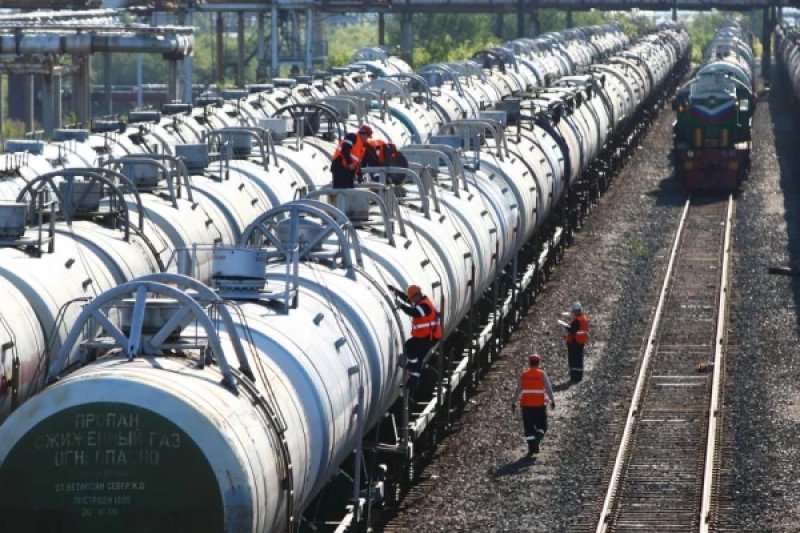
 Foto: BB.LV / жд цистерны
On Thursday morning, Bulgarian President Rumen Radev stunned Brussels by supporting the controversial diesel fuel supply deal agreed upon by U.S. President Donald Trump and Russian President Vladimir Putin — despite Western sanctions. "You know what our problem in Europe is right now? High fuel prices," Radev said in English upon arriving at a two-day summit of EU leaders. "We welcome any step aimed at reducing fuel prices and ensuring our competitiveness." His words contradicted the positions of other EU leaders, who sharply condemned the deal, calling it risky, dangerous, and misguided. To facilitate its implementation, the U.S. eased sanctions on the import of Russian diesel fuel, allowing its supply until April 2027. "We deeply regret this diesel fuel agreement. While the volumes may be small, it is a step in the wrong direction," noted Swedish Prime Minister Ulf Kristersson. "Any step that helps Russia increase funding for the war is a bad sign." Earlier on Thursday, EU foreign policy chief Josep Borrell stated in an interview with Euronews that the diesel deal was a gift for Putin at a time when Russia is intensifying its bombing campaigns. "The question arises: what did he (Putin) give in return? We see that, on the contrary, he is ramping up attacks on civilians and civilian infrastructure. The previously announced ceasefire by Russia is not being observed in practice," Borrell said. Another indication that Radev's position diverges from the common EU stance was his criticism of Ukraine's strikes on Russian oil refineries — actions that Donald Trump urged President Volodymyr Zelensky to cease immediately. Zelensky, in turn, indicated that these operations would continue. "I do not support strikes on any oil refineries," Radev stated. "I do not support strikes on any energy facilities — just as I do not support Russian attacks on Ukraine's energy infrastructure — because this ultimately hits us as well. Prices in Europe are rising rapidly." Most European leaders supported Zelensky, arguing that strikes on Russian refineries give Kyiv a powerful lever against Moscow. They view Trump's request as a desperate attempt to lower fuel prices ahead of the midterm elections, where Republicans risk losing control of both houses of parliament to Democrats. Since his election victory earlier this year, Radev has taken a position that runs counter to the prevailing European opinion regarding Russia's full-scale invasion of Ukraine. Recently, in an interview with Euronews, the Prime Minister stated that the EU's strategy based on the principle of "peace through strength" has failed and called on other European leaders to engage in diplomatic interaction with the Kremlin.
