

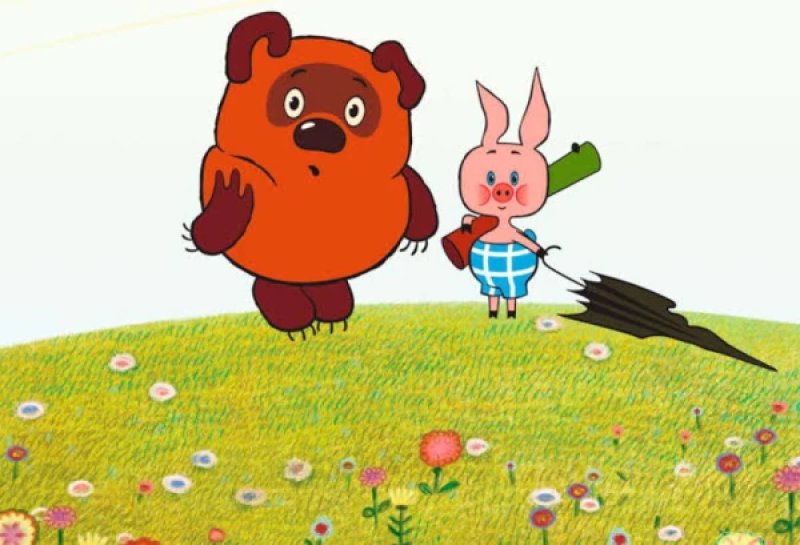
 Foto: BB.LV / Винни-Пух и Пятачок
The first book about Winnie the Pooh was published on October 14, 1926. Its author, British writer Alan Alexander Milne, was already a well-known playwright by that time. However, it was the stories about the plush bear that brought him worldwide fame, [reports](https://nos.nl/artikel/2634936-100-jaar-winnie-de-poeh-zonder-de-eerste-wereldoorlog-was-hij-er-niet-geweest) NOS. The illustrations for the book were created by artist Ernest Howard Shepard. Interestingly, Winnie the Pooh did not originally look like the version that modern children are accustomed to. He did not have the famous red shirt — this image became widely known thanks to the Disney company, which acquired the rights to adapt the works in the early 1960s. ## The Real Bear That Inspired the Writer The stories about Winnie the Pooh were written by Milne for his son Christopher Robin. The boy became one of the main characters in the books, and his favorite toys turned into inhabitants of the enchanted forest.  But the real Winnie the Pooh had a very real prototype. During World War I, a black bear became the mascot of one of the Canadian army units, receiving the name Winnie — a shortening of the name of the city Winnipeg. When the Canadian soldiers left England, the animal remained at the London Zoo. It was there that young Christopher Robin met the bear and loved her so much that he named his own stuffed bear after her. Later, this toy became the main character in his father's stories. The original toys of Christopher Robin — Winnie the Pooh, Tigger, Piglet, Eeyore, and Kanga — have survived to this day. They can be seen at the New York Public Library. ## The Enchanted Forest Actually Existed The famous Hundred Acre Wood, where the adventures of Winnie the Pooh and his friends unfold, also has a real prototype. After World War I, the Milne family settled in the English countryside. The writer purchased a farm with a large plot of land where his son could play for hours with his toys. According to historian Paul Muiris, it was this calm, secluded environment that became the basis for the enchanted world. "It’s an isolated, timeless world, yet innocent and incredibly safe," explains the researcher. He believes that the feeling of security and carefree living was one of the reasons for the immense popularity of the books. ## A Revolution in Children's Literature Today, the adventures of Winnie the Pooh seem like a familiar children's classic. However, a hundred years ago, Milne's books were a true innovation. In the first half of the 20th century, children's literature often had a didactic nature. Authors primarily aimed to teach children proper behavior and impart a moral lesson. Milne took a different path. As translator of the Winnie the Pooh books Annelies Jorn noted on Dutch radio NPO Radio 1, the stories of the British writer were much more playful and told from a child's perspective. According to her, Milne's books were groundbreaking precisely because they contained almost no direct moralizing. In the late 1920s, when European society was still grappling with the aftermath of the world war, the kind and cheerful stories about forest friends provided readers with a sense of joy and hope. That is why Winnie the Pooh became beloved not only by children but also by adults. ## What Do Piglet, Eeyore, and War Trauma Have in Common? Behind the apparent simplicity of the tales, researchers discover a deeper meaning. Alan Alexander Milne served in the British army during World War I. His experiences on the front left him with severe psychological consequences. According to some researchers, the writer may have transferred his own experiences into the characters of the fairy tale. For example, the donkey Eeyore is constantly in a state of gloom, Piglet experiences intense anxiety, and Rabbit seeks to control everything. Translator Annelies Jorn also points out the psychological traits of the characters. There is a suggestion that through these characters, Milne attempted to explain his own feelings and behavior to his young son. There are stories about how the writer was frightened by sounds that reminded him of the war. Once, he was scared by the buzzing of bees, mistaking it for the sound of bullets. The popping of balloons made him instinctively duck. Historian Paul Muiris believes that without World War I, the stories of Winnie the Pooh might never have appeared at all. At the same time, such psychological interpretations remain research hypotheses rather than established explanations of the writer's intent. ## Just Two Books — and Worldwide Fame Surprisingly, Milne wrote only two main books about Winnie the Pooh. The first was published in 1926, and the second — "The House at Pooh Corner" — in 1928. At the end of the second book, Christopher Robin, who is turning eight, goes off to boarding school. This reflected a real stage in the life of the writer's son. Despite such a small number of works, the stories of Winnie the Pooh quickly became a literary phenomenon. Historian Paul Muiris recalls that his own copy of the book, published in 1969, was already the sixtieth edition. Subsequently, the character's popularity increased many times over thanks to Disney cartoons. A hundred years later, Winnie the Pooh remains a symbol of friendship, kindness, and childhood innocence. And perhaps the secret of his longevity lies in the fact that amid the anxieties of the adult world, readers still find in the Hundred Acre Wood a place where friends help each other, mistakes can be corrected, and the biggest troubles usually end happily.
