

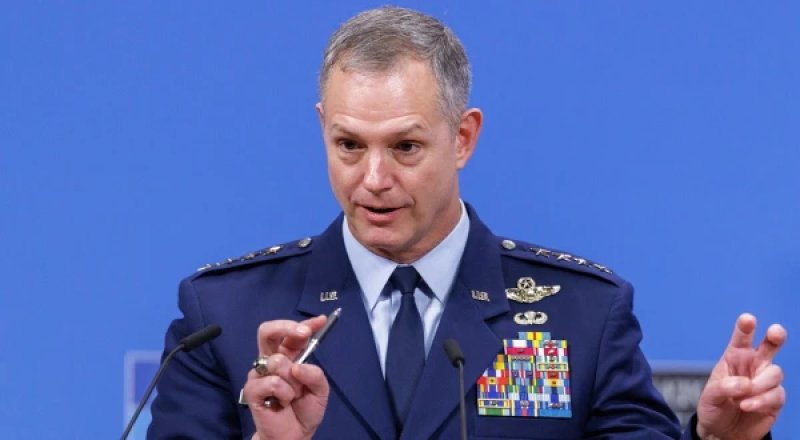
 Foto: BB.LV / Американский генерал Алексус Гринкевич.
According to him, Russian President Vladimir Putin prefers diversions and other covert methods of influence, as a direct military confrontation with the alliance would be extremely disadvantageous for Russia. In an interview with the German magazine Der Spiegel, published on Friday, October 16, the general stated that the military capabilities that NATO can deploy in a large-scale conflict significantly exceed those of Russia. As an example, he cited modern combat aviation and naval forces. According to Grinkevich, Russia does not have fighter jets comparable to the American F-35s, nor does it have as many modern military ships and submarines as the North Atlantic Alliance possesses. ## Why Putin does not want a direct confrontation Grinkevich expressed confidence that Russia will not initiate a full-scale conventional military offensive against Europe. In his assessment, Moscow uses other pressure tools, including diversions, as it does not have sufficient capabilities for direct confrontation with NATO. “Putin does not want a direct conflict,” the general emphasized. He explained this by the effectiveness of military deterrence provided by the alliance's armed forces. However, according to Grinkevich, to maintain this situation, NATO must continue to modernize its weapons, conduct large-scale exercises, and demonstrate its combat readiness. ## “We need to call things by their names” The general paid special attention to Russia's actions, which are often referred to as hybrid warfare or shadow warfare. In his opinion, such definitions are too vague and do not allow for a sufficiently accurate assessment of the nature of the threats. “We must call things by their names: diversion, arson, or terrorist act — these are precise terms that imply specific responses,” Grinkevich stated. When asked by journalists whether Europe is already at war with Russia, the general replied that Putin is playing a dangerous game. According to him, the Russian leadership is trying to convince European society that further support for Ukraine poses a threat and could lead to war with Russia. “He wants to convince our societies that supporting Ukraine is dangerous and that it could end in war against Russia,” Grinkevich noted. At the same time, the general emphasized that so far, this strategy has fortunately not brought Moscow the desired result. ## What will happen to the Kaliningrad region The interview also touched on the situation around the Russian exclave — the Kaliningrad region. Recently, threats have been voiced from Moscow that attempts to isolate the region or, even more so, to attack it would lead to war. Commenting on these statements, Grinkevich reminded that NATO is a defensive alliance. According to him, the alliance will act only in the event of an attack on it, so Russia has no grounds to fear aggression from NATO regarding the Kaliningrad region. At the same time, the general pointed out the changing military balance in the Baltic region. The war against Ukraine, in his assessment, has weakened Russia's positions in the Kaliningrad region, while NATO's presence and capabilities in the Baltic states have strengthened during this time. “From a military point of view, the situation there is unfavorable for Russia,” he emphasized. Grinkevich also noted that NATO's military exercises on the eastern flank are regular planned activities. The alliance, according to him, tries to avoid any actions that Moscow could interpret as aggression. ## Diversion in Germany could have led to numerous casualties One example of threats emanating from Russia, the general mentioned, was the attempted diversion at the German airport in Leipzig in August. According to German investigators, the target of the alleged attack was Ukrainian cargo planes. The German authorities attributed the incident to Russia. Grinkevich emphasized that even the mere attempt to carry out such a diversion is a serious violation. According to him, if the perpetrators had succeeded, several fully fueled Antonov cargo planes could have exploded. This would likely have resulted in human casualties. The general cited this case as an example of the danger of diversionary operations, which can have consequences comparable to serious military incidents. ## NATO urgently needs to increase drone production Despite the alliance's superiority in conventional weapons, Grinkevich acknowledged the need for accelerated modernization in certain areas of defense. First and foremost, this concerns unmanned aerial vehicles. The wars in Ukraine and Iran, according to him, have demonstrated the crucial role modern drones play on the battlefield. The general believes that NATO needs to rapidly increase its own capabilities in this area. “We need a large number of disposable strike drones, cheaper cruise missiles, and much more,” he stated. This involves creating mass and relatively inexpensive means of destruction that could complement costly modern weapon systems. ## NATO's strength must remain the main factor of deterrence Grinkevich is convinced that it is the military superiority of the North Atlantic Alliance that prevents Russia from a direct armed confrontation with European countries. However, maintaining this advantage requires constant investments, technological upgrades, and the armed forces' readiness for various scenarios. According to the American general, the main danger for Europe today lies not so much in a full-scale Russian invasion, but in diversions, arson, and other actions aimed at destabilizing European countries. At the same time, strengthening NATO's defense, especially on the eastern flank and in the Baltic region, should remain a key tool for deterring Moscow.
