

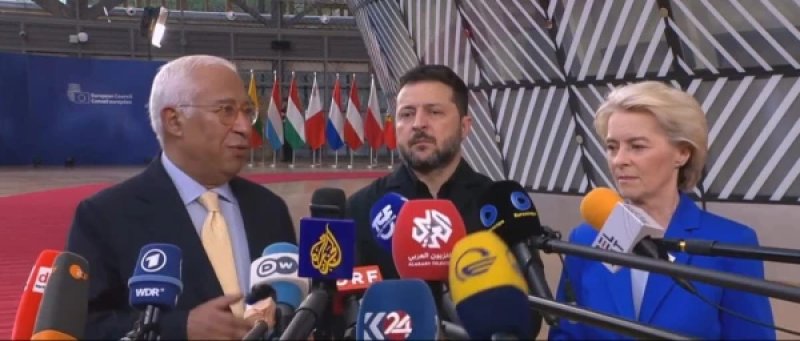
 Foto: BB.LV / Руководство Европейского союза на саммите в Брюсселе открыто выразило поддержку президенту Украины Владимиру Зеленскому.
“You can count on us,” said European Council President António Costa on Friday, October 16, speaking to reporters alongside Volodymyr Zelensky and European Commission President Ursula von der Leyen. This statement came after a series of critical remarks from U.S. President Donald Trump directed at the Ukrainian leader. ## Trump accused Ukraine of rising fuel prices Recently, Donald Trump has repeatedly criticized Zelensky for Ukrainian forces' strikes on Russian oil refineries. According to the American president, these attacks contribute to rising global fuel prices. Additionally, Trump called for a change in the president of Ukraine. At the same time, oil and fuel prices began to rise after the U.S. started a war against Iran at the end of February. The military actions led to the blockage of the Strait of Hormuz — one of the most important oil transportation routes in the world. Against the backdrop of the energy crisis, Washington is considering the possibility of easing some restrictions on oil supplies. This week, Reuters reported, citing an American official, that the Trump administration is discussing the possibility of easing sanctions against vessels of the so-called shadow fleet that transported oil and petroleum products from Russia, Iran, and Venezuela. Moreover, Trump has already temporarily lifted sanctions on Russian diesel fuel — until April 7. ## “Now is not the time to ease sanctions against Russia” European leaders opposed such an approach. “Now is not the time to ease sanctions against Russia. Now is the time to increase our support for Ukraine and intensify pressure on Russia,” emphasized European Council President António Costa. In Brussels, it is believed that easing restrictions on Moscow under the current conditions would send the wrong signal. European Commission President Ursula von der Leyen also called for the preparation of a new package of sanctions against Russia. ## The energy truce that did not work An additional source of disagreement was the energy truce announced by Trump between Russia and Ukraine. On Sunday, the American president unilaterally announced its introduction. According to Zelensky, Ukraine, albeit reluctantly, complied with Trump’s demand for three days, despite Russian forces continuing to strike Ukrainian energy facilities. Von der Leyen confirmed that the European Union supported the initiative of the American president, but Russia, according to her, did not comply with the terms of the truce at any moment. “Of course, we supported President Trump’s energy truce, but we saw that Russia did not comply with it for a single moment,” said the head of the European Commission. She added that instead of ceasing attacks, Moscow, on the contrary, intensified its strikes. ## Kyiv reports restrictions from the U.S. Tensions in the relationship between Ukraine and the United States are manifesting not only in public statements. According to Kyiv, Washington has reduced the volume of intelligence data provided to the Ukrainian side. Additionally, the U.S. has limited the use of the Starlink satellite internet service. Such measures raise concerns among the Ukrainian leadership, as American intelligence information and satellite communication play a crucial role in ensuring the country’s defense capabilities. In this context, support from European partners becomes even more significant for Kyiv. ## Ukraine will need tens of billions of dollars At the summit in Brussels, European leaders intend to discuss further financial support for Ukraine in the coming years. Last year, the European Union created a credit assistance mechanism for Kyiv amounting to 90 billion euros, intended for 2026 and 2027. Although funding for the Ukrainian budget for the current year is fully secured, Kyiv warns of a significant funding shortfall in 2027. In September, Ukrainian Finance Minister Serhiy Marchenko reported that the country would additionally need $32.6 billion to support the economy and another $45 billion for defense needs. Thus, the total need for additional funding amounts to $77.6 billion. ## Germany calls on Europe to increase aid German Chancellor Friedrich Merz stated on Thursday, ahead of talks with other EU leaders, that there is a need to increase financial support for Ukraine. In his opinion, European states will have to allocate more funds to Kyiv. Zelensky, who arrived in Brussels to participate in the summit, thanked the EU leadership for their support. Against the backdrop of deteriorating relations between Kyiv and Washington, European leaders are demonstrating a willingness to continue assisting Ukraine and oppose easing sanctions pressure on Russia. However, the main challenge for the EU will be not only political solidarity but also the ability to provide Kyiv with the necessary financial resources in 2027.
