

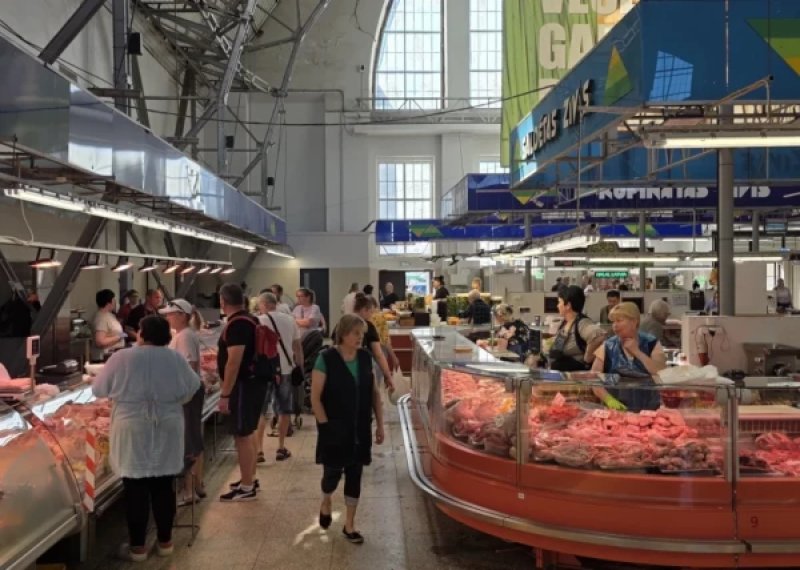
 Foto: BB.LV / рынок
At a meeting on October 14, the capital's municipality made a decision: in 2026–2030, the municipal company Rīgas nami is obliged to attract investments amounting to 21,200,000 euros, including value-added tax. It is planned to use the company's funds, financing from European Union funds and programs, loans, and other financial instruments. The money is intended for "the development, preservation, and restoration of the pavilions and the territory of the Central Market." ## "A green, smart, aesthetic, and accessible area..." This is how the municipality's document describes the "real estate located at Central Market Street, 1 (former Meat Pavilion) and the functionally necessary land plot." By May 2027, Rīgas nami is required to agree on the area and configuration of the plot with the Riga municipality's Property Department, as well as organize a rental rights auction for the facility and determine its development prospects. It is also emphasized that Rīgas nami has the right to lease the facility for up to 30 years, provided that technical, cultural-historical, and functional requirements are met. They did not forget about food: it is planned to offer "quality, affordable, and sustainable dishes and products," prioritizing local farmers, home producers, and organic products. Vice Mayor Edvards Ratnieks (National Alliance) acted as the political curator of the project at the plenary session of the Riga City Council: — I rely on the fact that the Central Market will continue to exist. And another good piece of news: until a big investor with a big wallet or bag comes to us, this is our own capital society. This way, we can keep an eye on everything, invite representatives of the company to faction and committee meetings, and ask them to report. — Do you believe that this investor will come, like Santa Claus? — ironically asked veteran politician Sergey Dolgopolov. — There is certainly hope, — Edvards Ratnieks does not give up. In particular, the capital's leadership plans to present the Central Market at specialized real estate forums. For example, at the MIPIM — the International Market of Real Estate Professionals — in beautiful Cannes! ## Linstow is not involved Andris Ozols, a current deputy and former head of the Latvian Investment and Development Agency, was puzzled: why could the announced investment amount not have been anticipated earlier and allocated to first carry out urgent roof repairs of the Meat Pavilion? — You are right, — immediately found a professional lawyer Edvards Ratnieks. According to him, renovations of the pavilions had already been carried out previously. Now, however, it is not so much about eliminating threats to the buildings as it is about changing the external and internal space. "Making the market meet the requirements of the 21st century" — this is what the city authorities are striving for. Deputy Edvards Šlesers called the result of the Central Market working group "absolutely pathetic." — The best we could squeeze out is to borrow more money. Rīgas nami belongs to the municipality, — the deputy reminded. — That is, the municipality is borrowing from itself! As an alternative, Edvards Šlesers proposed holding an international competition for the development of a master plan for the entire territory of the Central Market and its integration into the urban environment. Instead, Rīgas nami proposed a sketch competition, which, according to the deputy, will not help attract any investors. Furthermore, Mr. Šlesers stated that Ojars Valkers, the chairman of the board of Rīgas nami, who was absent from the council meeting, had previously claimed to have held preliminary negotiations with the largest development company in the Baltics, Linstow. However, representatives of the latter subsequently denied their involvement in projects at the Central Market. — The Agenskalns market is a fantastic example of how a market can be handed over to a private entity without investing a cent, — stated the opposition deputy. ## "It’s time to end the Soviet Union" With this trump card, Ansis Pupols (National Alliance) began his speech. He called the current state of the trading enterprise "terrible." The deputy chairman of the Committee on the Environment and Mobility also proposed turning the Central Market into a transport hub and a place for children's entertainment. — We also cannot give everything to one investor, — emphasized A. Pupols, mentioning Lidl in this context: "We don’t need that." Rudolfs Bremanis (Sovereign Power / Young Latvians) noted that the silence around the market before the elections and the current activation are particularly indicative. In his opinion, "everything will benefit construction firms": — With whom, probably, everything has already been agreed: how, who, and for how much. The matter will definitely not be limited to a couple of dozen million euros, suggested R. Bremanis. "We have heard arguments that it needs to be plastered, and then it will be easier to find an investor," — the deputy remarked ironically. He also recommended working in the same manner with the building of the former RTU, which has been silently towering in the Old Town next to the Riga City Council for many years. — What I have heard in the corridors is Lidl, — continued the deputy. — There is already Maxima, which local traders are shocked by: they are dumping Lithuanian products. Now German products will appear in Lidl. ## A holy place is never empty? The consequence of such proximity, R. Bremanis warned, could be the departure of Latvian farmers, who are already struggling with rising rents. Meanwhile, the location of the Central Market next to the Old Town and the railway station opens up truly wide opportunities for development, including skyscrapers, pointed out the former diplomatic representative of Latvia in the UAE. Instead, in his opinion, "there will be a degraded area in the center of Riga, where nothing is developing." The coalition parties will secure a feeding trough for themselves on repairs and parking — and that will be the end of it, while the situation in the market will remain more or less the same as in the 1990s. Andris Ozols, however, is more optimistic: the Central Market is "the pearl of Riga." And even if consumer preferences change, the market will still be able to find its place.
