

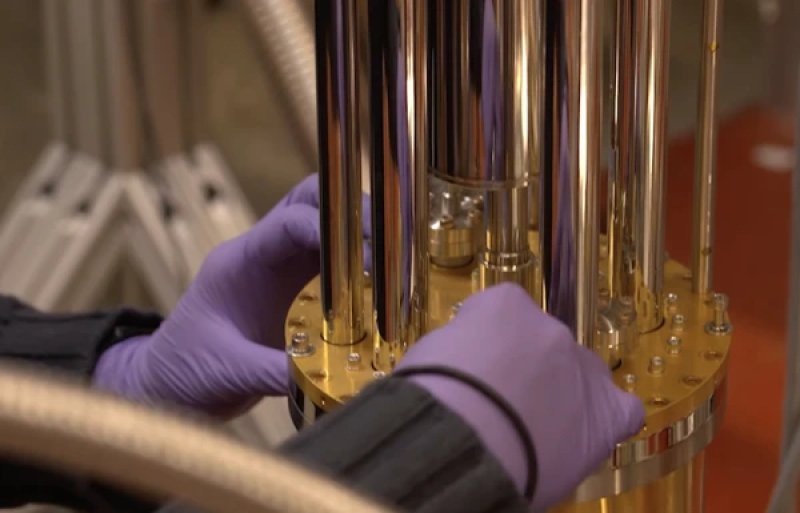
 Foto: BB.LV / научный эксперимент
Why is our universe predominantly made of ordinary matter, even though the Big Bang should have produced roughly equal amounts of matter and antimatter? This question remains one of the main mysteries of modern physics. According to current understanding, every elementary particle has a corresponding antiparticle. When a particle and its antiparticle meet, annihilation occurs — their mass is converted into energy. If equal amounts of matter and antimatter were indeed formed in the early universe, the question arises: why didn’t they completely annihilate each other? Scientists are searching for answers, including through experiments with individual antiparticles. However, studying them is extremely difficult: even a random contact with ordinary matter is enough for an antiparticle to disappear. Now, researchers from Northwestern University in the United States have reported an important achievement. They managed to isolate a single positron and keep it trapped for several months. ## How to Catch a Particle Moving Almost at the Speed of Light A positron is the antiparticle of an electron. It has the same mass but a positive electric charge. Positrons naturally occur during certain types of radioactive decay, high-energy particle collisions, and cosmic processes. Physicists have been able to detect them since the 1930s. But for highly accurate measurements, it is necessary not just to detect a positron but to capture it, slow it down, and completely isolate it from ordinary matter. The main difficulty lies in the fact that positrons produced during radioactive decay have very high energy. > "The biggest challenge is to slow down the positron that is ejected from the nucleus during radioactive decay with very high energy enough so that we can capture it in our particle trap," said physicist Gerald Gabrielse, the senior author of the study, to [ScienceAlert](https://www.sciencealert.com/physicists-trapped-a-particle-of-antimatter-and-kept-it-caged-for-months). In the experiment, a radioactive sodium isotope was used, emitting positrons with energies up to 546 kilo-electronvolts. This corresponds to a speed of about 88% of the speed of light. To capture such a particle, it must first be significantly slowed down. ## Tungsten Crystal and a Trap Colder than Space The team led by physicist Tom Myers developed a setup consisting of three main elements: a radioactive source, a tungsten monocrystal, and an electromagnetic trap. First, positrons were directed into the tungsten crystal. Interacting with its atoms, they lost a significant portion of their energy. Most antiparticles annihilated upon colliding with electrons. However, some managed to exit the crystal in a special state — as a highly excited positronium. Positronium is a bound system of an electron and a positron. In this case, the particles were far enough apart to delay their annihilation for a short time. This time was sufficient to direct the system through a hole just 640 micrometers in diameter into the trap. There, an electric field separated the electron from the positron. To hold the remaining antiparticle, the scientists used a Penning trap — a device in which electric and magnetic fields prevent a charged particle from touching the walls. Inside, an extremely deep vacuum was maintained, and the temperature was only 300 millikelvins, or approximately minus 272.85 degrees Celsius. This is significantly colder than the natural temperature of the cosmic microwave background. In such conditions, the positron could remain isolated for several months. ## Scientists Learned to Control a Single Antiparticle The prolonged capture of the positron itself was an important result, but the researchers went further. In the magnetic field of the trap, the particle performs circular motion known as cyclotron motion. The scientists cooled the positron to its minimum quantum energy state and then learned to transition it between individual energy levels using microwave radiation. Moreover, the change occurred one quantum of energy at a time. The researchers also managed to register these transitions and changes in the spin of the positron without destroying the measured quantum state. > "My research group and I have worked for many years to create a single-particle quantum cyclotron for the positron, so it was extremely gratifying to observe the positron making energy transitions by one quantum," Gabrielse admitted. Such precision in control opens up opportunities for experiments that were previously extremely difficult to conduct. ## Why This Experiment Is Important for Understanding the Universe One of the main goals of the researchers is to test a fundamental principle known as CPT symmetry. It suggests that the laws of physics remain unchanged when three transformations are simultaneously applied: replacing particles with antiparticles, reflecting space in a mirror, and reversing the direction of time. This implies that certain characteristics of a particle and its corresponding antiparticle should match with very high precision. For example, electrons and positrons have magnetic moments — properties that cause them to behave like tiny magnets. According to theory, the magnetic moments of the electron and positron should be equal in absolute value but opposite in sign. The magnetic moment of the electron has already been measured with exceptionally high precision. Now scientists hope to conduct equally precise measurements for the positron. If the results match theoretical predictions, it will be one of the most stringent confirmations of CPT symmetry. If a discrepancy is found, it may point to physical phenomena that are not yet described by the Standard Model of elementary particles. ## When Will the Results Be Known The researchers continue to work on measuring the magnetic moment of the positron and hope to present results early next year. However, Gabrielse warns that achieving the necessary precision may take more time. Even if the experiment fully confirms existing theoretical views, the main mystery will remain unsolved. > "This will only deepen the mystery of how the Standard Model can predict the results of our measurements so accurately while remaining incompatible with the fundamental features of the universe," noted the physicist. The new technology does not yet explain why there is much more matter than antimatter in the universe. But it provides scientists with a tool to test the laws of nature with a precision that was previously unavailable when studying individual positrons.
