

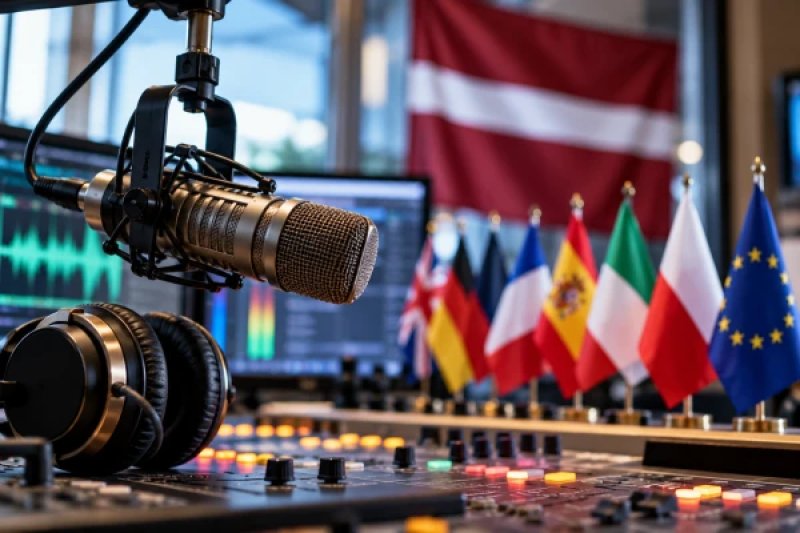
 Foto: BB.LV / Латвийские радиостанции смогут вести вещание не только на государственном языке, но и на языках других стран Европейского союза.
The relevant amendments to the Electronic Media Law were adopted by the Saeima on Thursday, October 22, in the final reading. The initiator of the changes was the Minister of Culture Nauris Puntulis (National Alliance). The aim of the amendments is to clarify the rules for forming radio programs and issuing broadcasting permits. Initially, the draft law proposed stricter restrictions. During its consideration, the parliament supported a provision stating that broadcasting permits should be issued exclusively for programs in the state language. However, by the final reading, the approach changed. The deputies decided to allow radio stations to also use the languages of other European Union member states. Thus, radio programs will be able to be broadcast not only in Latvian but also, for example, in English, German, French, Polish, and other languages of EU countries. ### A dispute arose over terminology During the consideration of the draft law, the deputies also discussed a proposal from the Latvian Society of the Deaf to replace the term *pieejamība* (“accessibility”) in the legislation with *piekļūstamība* (“usability,” including for people with disabilities). The authors of the initiative referred to changes in terminology in the European Directive on audiovisual media services. However, the Legal Bureau of the Saeima and several deputies pointed out that the meanings of these concepts do not fully coincide, so the issue requires more detailed consideration. As a result, the proposal was not included in the adopted amendments. It is planned to revisit it when preparing a separate package of amendments to the Electronic Media Law. ### From restrictions to broader opportunities Let us remind you that at the end of July, the Saeima approved the draft law in the second reading. At that time, it was assumed that broadcasting permits would be issued only for programs in the Latvian language. Now, the parliament has revised this position, allowing the use of languages from other EU countries. At the same time, the adopted amendments do not provide for a similar permit for the Russian language, as it is not an official language of any EU member state.
