

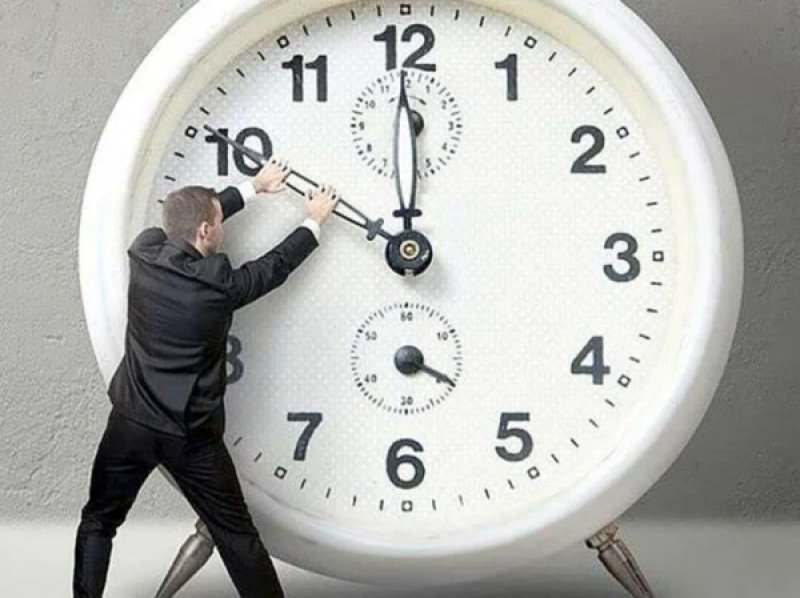
 Foto: BB.LV / человек с циферблатом
The overwhelming majority of the EU population considers the seasonal clock change unnecessary. Sociologists come to this conclusion almost annually — for nearly ten years now. In 2018, during a survey conducted across the European Union, 84% of respondents opposed the switch from winter time to summer time; the most opponents of the clock change were found in Germany. In 2019, the vast majority of Members of the European Parliament supported the European Commission's proposal to abolish the biannual clock change. However, this decision has still not been implemented. Initially, the EU leadership had enough concerns with overcoming the crisis caused by the global coronavirus pandemic, and then came Russia's full-scale invasion of Ukraine. Moreover, according to surveys, resistance to the clock change has somewhat weakened recently. ## ## On Sunday Morning — Transition to Winter Time Traditionally, the clock change occurs on the last Sunday of October. On the night of October 24 to 25, 2026, the clocks will be set back from 3:00 to 2:00. This means that those who do not need to work night shifts will be able to sleep an hour longer (while night workers, on the contrary, will work an extra hour). As a result, it will get light earlier in the mornings, and evenings will come earlier. ## With the transition at the end of October, Central European Summer Time (MESZ) ends — and Central European Time (MEZ), often referred to as "winter time," comes back into effect across most of Europe. In Portugal and the United Kingdom, the clocks are also changed, but this happens an hour earlier due to a different time zone. ## ## In the USA, Daylight Saving Time Ends Only on November 1 According to Reisereporter, Morocco, Thailand, Japan, Argentina, and South Africa do not change their clocks. In 1980, the Federal Republic of Germany and other EU countries joined France to unify time. Back in 1976, the government in Paris introduced Daylight Saving Time in response to the oil crisis — aimed at saving energy. Today, this argument is considered outdated. ## Russia Has Its Own Path In Russia, clocks are not changed to winter or summer time — the country operates on permanent time year-round. Moreover, seasonal time changes are prohibited by federal law "On Time Calculation" (Article 4), so this Sunday the clocks in the country will remain unchanged. After experiments with permanent "summer" time in 2011, in the fall of 2014, Russia finally switched to permanent standard time. The country has 11 time zones, and Moscow is permanently in the UTC+3 time zone. ## ## EU Council Blocks the Abolition of Clock Changes In 2019, the European Parliament voted (410 votes in favor, 192 against) to abolish the clock change — it was initially planned to take effect starting in 2021. However, the final law required the consent of EU member states, which was not obtained. So far, countries have been unable to agree on which time — summer or winter — should be in effect permanently. Since introducing different time regimes could create economic and organizational difficulties, the implementation of this plan is postponed until a common solution is found. Thus, the abolition of the clock change is not expected in the near future.
