

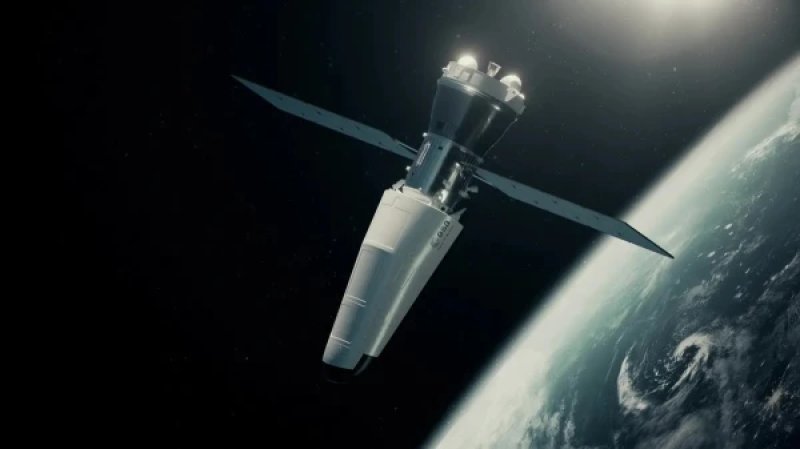
 Foto: BB.LV / Space Rider
The test took place on October 6 at a military range on the Italian island of Sardinia. A full-scale model of the Space Rider, the size of a minivan, was dropped from a helicopter from an altitude of about three kilometers to test the return and landing system, writes [Space](https://www.space.com/space-exploration/launches-spacecraft/europes-space-rider-vehicle-comes-crashing-down-during-drop-test). Initially, everything went according to plan. A small brake parachute successfully deployed and began to slow the descent of the vehicle. Then the main controlled parachute was supposed to deploy, allowing the Space Rider to be directed to a designated landing point. However, during the deployment of the main parachute, it unexpectedly detached. The vehicle lost the ability to descend in a controlled manner and crashed upon impact with the ground. ESA confirmed the failure of the test and announced the start of an independent investigation. "After several successful tests using models that matched the weight of the actual vehicle, the last comprehensive drop test in October was unable to be completed as planned due to an anomaly during the deployment of the controlled parachute," said a spokesperson for the agency. According to him, the investigation will determine the cause of the incident and outline further actions. All components of the crashed model were recovered. ### Why Europe needs Space Rider Space Rider is being developed as the first European reusable orbital spacecraft. Unlike crewed ships, it is intended for uncrewed scientific missions. The vehicle will be able to deliver experiments to orbit, remain there for up to two months, and then return to Earth. After landing, scientists will be able to study the research results, and the vehicle is expected to be prepared for reuse. One of the main features of Space Rider is its return method. It does not have wings like space shuttles. Instead, it uses a lifting body and a large controlled parachute that allows maneuvering during descent and landing on a pre-selected site, including a runway. This technology was what engineers were trying to test during the October trial. Its reliability is crucial for safely returning the vehicle after orbital missions. ### Not the first test with problems The program for testing the descent and landing systems of Space Rider began in 2025. Prior to the current failure, engineers had conducted several successful tests that confirmed the deployment of the controlled parachute and the operation of the autonomous control system. However, in May, another test had to be canceled even before the model was dropped. One of the sensors detected a malfunction during preparations, and engineers decided not to take any risks. Subsequently, the tests had to be postponed for several months: the military range in Sardinia was unavailable from June to September. The October drop was the first attempt to resume testing after this break. Meanwhile, other systems of Space Rider continue to undergo testing. Earlier in 2026, engineers tested the materials of the thermal protection shield, exposing them to temperatures around 1600 degrees Celsius in a plasma wind tunnel. Such protection is necessary for the vehicle's return to Earth when its surface is subjected to extreme heating upon re-entry into the atmosphere. ### Will the accident affect the first flight? Despite the loss of the test model, ESA does not currently anticipate a significant revision of the development schedule. The agency's director of space transportation, Géraldine Naja, stated at a briefing on October 22 that the remaining qualification tests are not on the critical path of the project. "We hope that this test will not harm the further schedule and qualification activities or, shall we say, force us to revise them," she noted. Naja described the incident as unfortunate but an important stage of development, emphasizing that tests are necessary to identify issues before actual space missions begin. At the same time, the crashed vehicle was not a ready-to-fly orbital spacecraft. It was a specially created full-scale model that replicated the dimensions, weight, and flight characteristics of the return module. It also had onboard electronics for autonomous control and navigation. ESA still hopes to send Space Rider on its first orbital flight by the end of the decade. Thus, the accident revealed a problem in one of the key systems of the future reusable vehicle, but it has not yet led to an official postponement of its launch schedule.
