

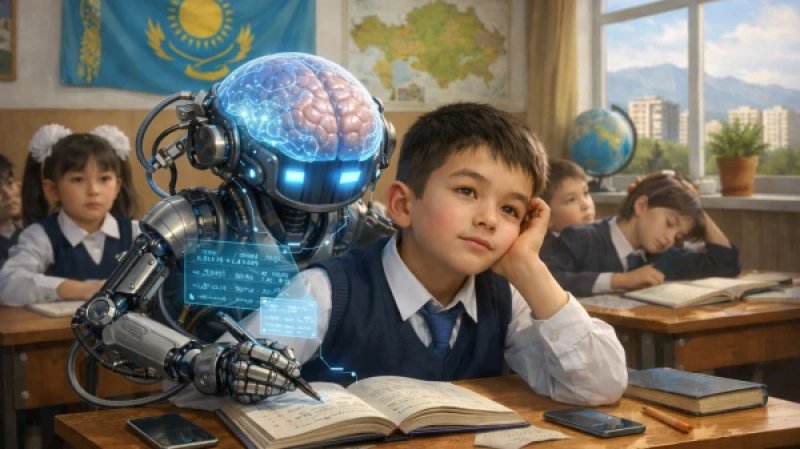
 Foto: BB.LV / Так ли хороша и безопасна ИИ-помощь для подростка?
**Olga Medvedeva, psychologist** ## Help! Of course, it is more convenient and faster for parents to do something themselves rather than spend time first explaining and then controlling or redoing the task assigned to the child. How often do you say, “Let me do it, I’ll do it faster”? Instant results are undoubtedly achieved with less effort, but in the long term, the opposite is true. The brain is a lazy thing; it quickly gets used to the idea that to solve a problem/task, one just needs to find someone who will say, “Let me do this for you.” And why look for someone when a helpful and always ready AI lives in the smartphone? This leads to what is scientifically called the mechanism of cognitive decline. **Aspects:** • Intellectual laziness: The brain is plastic and works on the principle of “use it or lose it.” Without strain, neural connections weaken. • Decreased concentration: The habit of receiving instant solutions destroys the ability to maintain focus on complex, multi-step tasks for long periods. **Antidote:** • The principle of the first step: Always make the first attempt to solve the task or create a plan independently, without launching the neural network. ## “I am tormented by vague doubts…” For children and adolescents, whose personalities are still in the process of formation, artificial intelligence can become an extremely misleading authoritative figure. After all, if someone doesn’t make mistakes and doesn’t lie, can they be trusted? And that small print at the bottom stating, “There may be errors in the responses of artificial intelligence,” is not that important. The main problem is that AI handles precise tasks well but struggles significantly with analyzing the reliability of the arrays of judgments uploaded to the network. For example, consider the well-known joke about mushrooms (all mushrooms are edible, but some only once). AI does not see the irony in this; for it, the mere fact that a mushroom is edible is sufficient. The note about “only once” is perceived by it as “once” for the mushroom, not for the eater. To verify the claim about edibility, one must doubt the expert position of AI, but modern education and upbringing systems do not teach doubt. **Aspects:** • Degradation of search behavior: People unlearn to compare different sources, check facts, and doubt. AI provides a ready, smooth answer. • Vulnerability to manipulation: A society with weakened critical thinking becomes an easy target for fakes and targeted propaganda. **Antidote:** • The rule of strict verification: Never take facts, dates, and numbers from AI at face value; always double-check them in search engines.  ## Man to man... who? Lockdowns and remote work have hit children's communication skills much harder than it seems. After all, it is in childhood that a person trains and hones the mechanisms of safe and successful survival strategies among their peers (and even those who are completely NOT similar). It is completely clear that neither personal boundaries nor the limits of what is permissible in relation to others can be learned from books. Nothing can replace personal practical experience. The conflict-free and calm communication environment offered by artificial intelligence can distance a child from the complex and sometimes exhausting social interactions of real life. Real people make mistakes, reject, and do not always approve, while AI models, on the contrary, are usually optimized to please and support. As a result, the need for social approval is satisfied from an artificial source, leading to isolation from society, during which social skills weaken and feelings of alienation intensify. **Aspects:** • Refusal of live connections: People less frequently seek support from friends and family. The circle of real communication narrows. • Loss of empathy skills: Communication through templates of “text in response to text” makes people unlearn compromise and consideration of the feelings of a living partner. • Availability 24/7: The neural network responds instantly and does not tire of the topic. **Antidote:** Behavioral activation (Return to reality) • Micro-contacts: Start small—greet neighbors, exchange a couple of phrases with the barista or cashier. • Call ritual: Choose one day a week for an obligatory voice call with a friend or relative, rather than texting. • Common interests: Enroll in live courses, a gym, or a club where interaction with people is inevitable (dancing, board games, volunteering). “To ensure that future generations can build a healthy social structure, they need to be raised with the understanding that technology is not an end in itself, but merely a controlled tool.” ## Three Laws of Robotics The rules of robotics are the famous Three Laws, conceived by science fiction writer Isaac Asimov in 1942. They describe the safe behavior of smart machines and artificial intelligence. • First Law: A robot may not injure a human being or, through inaction, allow a human being to come to harm. • Second Law: A robot must obey the orders given it by human beings, except where such orders would conflict with the First Law. • Third Law: A robot must protect its own existence as long as such protection does not conflict with the First or Second Laws.
