

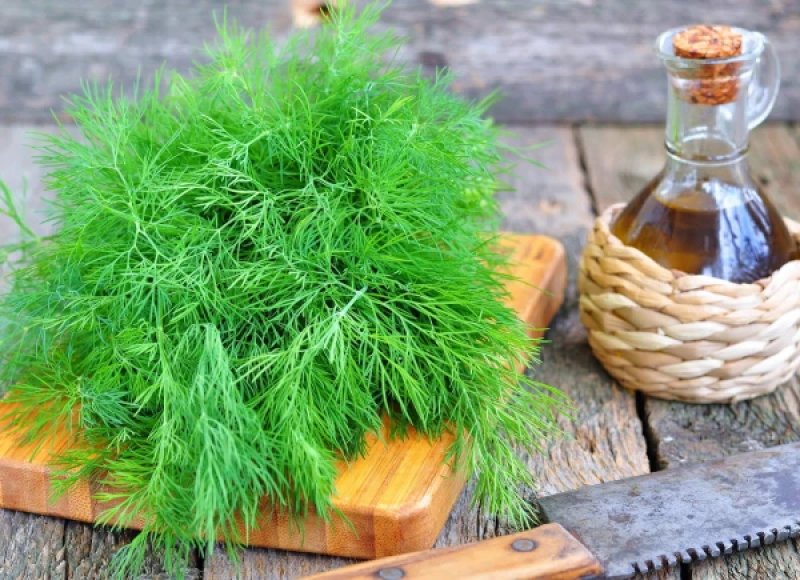
 Foto: BB.LV / Укроп
What is really known about the benefits of dill, and which of its properties still need to be proven? Dill can be found in almost every kitchen. It is used fresh, dried, added to marinades, sauces, vegetable and meat dishes. At the same time, most people perceive it solely as a fragrant seasoning. Meanwhile, interest in dill has long gone beyond cooking. Scientists are studying the biologically active substances contained in it and their possible influence on the human body. As biochemist and food behavior specialist Anna Divinskaya told the publication "Doctor Peter," researchers are particularly interested in two areas: the effect of dill on digestion and its potential calming properties. In the first case, there are already results from clinical trials involving people, while in the second, scientific data is still significantly less. ## What Lies Hidden in a Common Sprig of Dill? Dill contains a whole complex of natural compounds that determine its characteristic aroma and biological properties. Particularly interesting are the components of the essential oil: - **Carvone** — an aromatic substance that is being studied in connection with its possible influence on the smooth muscle of the digestive tract. - **Limonene** — a natural compound also found in citrus plants. - **Alpha-phellandrene** — one of the components that form the characteristic smell of dill. - **Apiol** — a biologically active compound that requires caution when using concentrated plant preparations. In addition, the greens and seeds of dill contain flavonoids, and fresh greens serve as a source of vitamin C, potassium, and dietary fiber. It is the combination of various substances that attracts the interest of researchers. In laboratory experiments, some components of dill demonstrate spasmolytic activity, meaning the ability to reduce contractions of smooth muscle. This may potentially explain the traditional use of the plant for abdominal discomfort. However, it is important to consider that the content of active substances in a typical portion of greens differs significantly from their concentration in extracts and essential oils used in studies. ## Dill Against Bloating: What Scientists Have Found In folk medicine, dill has long been used for flatulence, a feeling of heaviness, and intestinal spasms. The so-called dill water is particularly well-known, although pharmacy products with that name are often made from fennel rather than ordinary garden dill. Modern studies suggest that there may indeed be a physiological explanation for the traditional use of dill. A double-blind placebo-controlled study involving 118 women after cesarean section was published in the journal *Complementary Therapies in Clinical Practice*. The participants were divided into groups: one received a preparation with dill essential oil, while the other received a placebo. Researchers assessed the severity of postoperative abdominal bloating, flatulence, and related discomfort. According to the results presented, women receiving the dill preparation experienced less pronounced symptoms than those in the control group. The authors suggested that the effect may be related to the spasmolytic properties of the components of the essential oil and their impact on intestinal function. However, the results of one study conducted in a specific group of patients cannot be automatically generalized to all people with digestive disorders. Moreover, the use of a special preparation is not equivalent to consuming ordinary greens. ## Another Study: Dill and Intestinal Function in Diabetes Scientists also studied the possible effects of regular consumption of dill preparations. In one randomized controlled trial, people with type 2 diabetes participated. Some participants received three grams of dill powder daily for several weeks. Researchers assessed not only individual metabolic indicators but also the severity of gastrointestinal symptoms. According to the data presented by the specialist, the dill group showed improvement in several indicators, including a reduction in some digestive complaints. This is of interest since it is not a laboratory experiment but a study involving people. However, such results require confirmation in larger trials. It is also necessary to determine how sustainable the effect is and in which patients it may manifest most noticeably. The main limitation: there is currently insufficient evidence to assert that the ordinary addition of dill to food provides the same result as the intake of standardized preparations in clinical studies. ## Why Can Dill Aid Digestion? One possible mechanism is related to the work of the smooth muscles of the intestine. Under normal conditions, the muscles of the walls of the digestive tract contract rhythmically, helping to move food and gases. However, in some functional disorders, stress reactions, and diseases, painful spasms can occur. These can be accompanied by a feeling of distension, bloating, and discomfort. Researchers suggest that certain components of dill may influence the contractions of smooth muscles and thereby reduce some unpleasant sensations. Essential oils of the plant may play an important role. But the mechanism of their action in humans is not yet fully understood. Moreover, bloating is not always related specifically to spasms. Causes can include dietary habits, intolerance to certain foods, constipation, and gastrointestinal diseases. Therefore, dill cannot be considered a universal remedy for such symptoms. ## Can Dill Really Soothe Nerves? An even more unexpected area of research concerns emotional states. In traditional medicine, dill has sometimes been attributed with mild calming effects. Modern scientists are trying to determine whether there are biological grounds for this. In some animal experiments, extracts of dill seeds demonstrated anxiolytic activity — that is, a reduction in behavior that researchers associate with anxiety. In particular, such results were obtained in experiments on laboratory rats. The authors of one study suggested that certain phytoestrogenic properties of plant compounds may play a role. However, an important caveat must be made here. **Animal experiments do not prove that dill can reduce anxiety in humans.** The human nervous system is more complex, and the dosages of substances used in laboratory studies may differ significantly from the amounts that enter the body through food. Therefore, there is currently insufficient basis to recommend dill as a standalone treatment for anxiety disorders. ## What Is the Connection Between the Gut and the Brain? In recent years, scientists have been actively researching the so-called "gut-brain axis." This is a complex system of bidirectional interaction between the digestive tract and the central nervous system. It involves nerve pathways, hormones, immune mechanisms, and gut microbiota. It is known that stress can affect gut function, causing changes in motility, pain, and other unpleasant sensations. There is also feedback: prolonged digestive discomfort can worsen emotional well-being. Therefore, specialists suggest that reducing unpleasant sensations in the abdomen may indirectly contribute to a subjective feeling of calm. But this does not mean that dill directly affects the brain as a calming agent. For now, it is only a possible correlation that requires further study. ## How to Properly Use Dill? The simplest way to include dill in the diet is to regularly add fresh greens to familiar dishes. It pairs well with vegetables, potatoes, fish, dairy products, and various soups. When used in ordinary cooking, dill is safe for most people and helps diversify the diet. Folk practices also use infusions of dill seeds. One traditional preparation option is a teaspoon of seeds in a glass of boiling water, steeped for 10–15 minutes. However, this recipe should not be regarded as a clinically confirmed therapeutic dosage. The concentration of active substances depends on the amount of seeds, preparation conditions, and other factors. It is especially important not to confuse a homemade infusion with concentrated essential oil. **Dill essential oil should not be taken internally on its own for therapeutic purposes.** High concentrations of certain plant compounds can be unsafe. Pregnant women, people with chronic diseases, and those who regularly take medications should discuss the use of concentrated extracts or therapeutic doses of seeds with a doctor beforehand. ## When Dill Will Not Help Despite the promising results of individual studies, dill is not a substitute for medical treatment. It cannot independently eliminate the causes of irritable bowel syndrome, chronic inflammatory diseases of the digestive tract, or anxiety disorders. If bloating, pain, or other symptoms recur regularly, it is necessary to determine their origin. It is especially important to consult a doctor if blood appears in the stool, there is unexplained weight loss, persistent vomiting, severe pain, or other alarming signs. In such cases, attempts to cope with the problem solely through herbal infusions may lead to delays in diagnosis. ## Conclusion: Familiar Greens Deserve More Attention The story of dill shows that even the most ordinary products can contain substances of interest to modern science. Some clinical studies provide grounds to explore dill preparations as a potential adjunctive treatment for certain digestive disorders. Data on its effects on anxiety are still much less convincing and have been obtained primarily in animal experiments. Nevertheless, dill remains a useful addition to a varied diet — a source of aromatic compounds and some nutrients. Perhaps the main secret of this familiar herb lies not in miraculous properties but in the fact that even simple products can have a more complex effect on the body than we tend to think. And while it is premature to turn dill into a medicine, it should not be regarded solely as a plate decoration either.
