

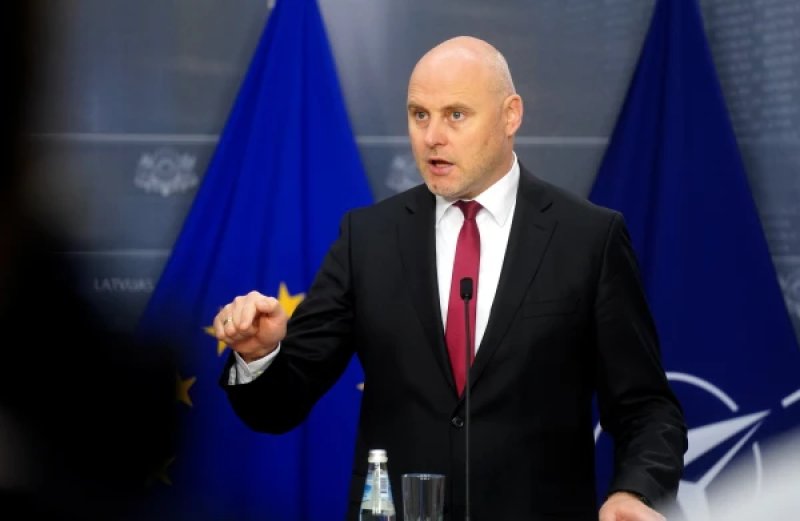
 Foto: BB.LV / Андрис Кулбергс
On Monday, October 26, Kulbergs gathered the newly elected deputies of the "United List" (UL) to discuss political priorities, preparations for the work of the new Saeima, and upcoming negotiations on forming a government. The location of the meeting was not publicly disclosed. According to the Prime Minister, the participants managed to agree on the further course of action and the principles that the UL will follow in negotiations about the work of the next government. "Society has given us a mandate for change. Urgent change. Change that, in my opinion, implies greater responsibility, more careful use of public funds, and concrete decisions," emphasized Kulbergs. ### "There Will Be Unpopular Decisions" The chairman of the Latvian Green Party (LGP), which is part of the "United List," Edgars Tavars, reported after the meeting that the deputies supported the reforms and priorities proposed by Kulbergs for the future government. He stated that the meeting lasted almost the entire day and took place in a constructive atmosphere. "It was a lengthy working meeting dedicated to what needs to be done in the government and parliament so that society truly sees change. Changes will happen, but they will not be easy. There will be unpopular decisions," warned the politician. Particular attention was given by the meeting participants to stimulating economic development, strengthening budget discipline, and reducing government spending. Issues of security and other areas crucial for the country's development were also discussed. ### "Full and Unconditional Support" Tavars noted that Kulbergs had thoroughly prepared for the meeting and presented his vision for the upcoming reforms in detail. "Kulbergs' reforms enjoy full and unconditional support from the 'United List'," stated the chairman of the LGP. He expressed confidence that all newly elected deputies of the coalition would support the agreed political course. According to Tavars, internal disagreements or a split within the "United List" should not be expected. Kulbergs himself explained that before the start of official negotiations with other parties, it was important for him to secure understanding, support, and active participation from the deputies of his political coalition. Earlier, the Prime Minister reported that the plan for change developed by the UL is nearly ready and will soon be presented in detail to the parliamentary faction. ### Who Does Kulbergs Intend to Form a Coalition With? The main potential partners for the "United List" remain the National Alliance and "New Unity." As Tavars reported, these political forces are being considered as priority participants in negotiations to form the next government. At the same time, he acknowledged that theoretically, the creation of a minority government cannot be completely ruled out. However, according to the politician, at this time, the "United List" is not intentionally moving towards such a scenario. The first meetings with potential partners are scheduled for October 28. On that day, representatives of the UL plan to hold negotiations with the National Alliance and "New Unity." More detailed information about the planned transformations and priorities of the government will be presented by Kulbergs after these negotiations. ### What Are They Planning to Save On? Earlier, Kulbergs emphasized that the formation of the government should begin not with the distribution of ministerial portfolios, but with the agreement on principles of cooperation, specific transformations, and accountability for achieving results. The plan developed by the "United List" includes several main directions: - Increasing the efficiency of government operations. - Strengthening budget discipline. - Reducing bureaucracy. - Decreasing government spending. - Stimulating economic growth. However, specific measures for savings and a list of possible cuts have not yet been publicly presented. ### 41 Mandates — The Basis for the Future Government Recall that following the elections to the 15th Saeima, the "United List" received 41 deputy mandates, becoming the largest political force in the new parliament. The President of Latvia, Edgars Rinkēvičs, tasked UL representative Andris Kulbergs with forming the next government. Thus, after aligning positions within his own faction, Kulbergs moves to the next stage — negotiations with potential partners. The main intrigue now lies in what specific unpopular decisions the future cabinet of ministers is ready to propose and which political partners will agree to take responsibility for their implementation.
