

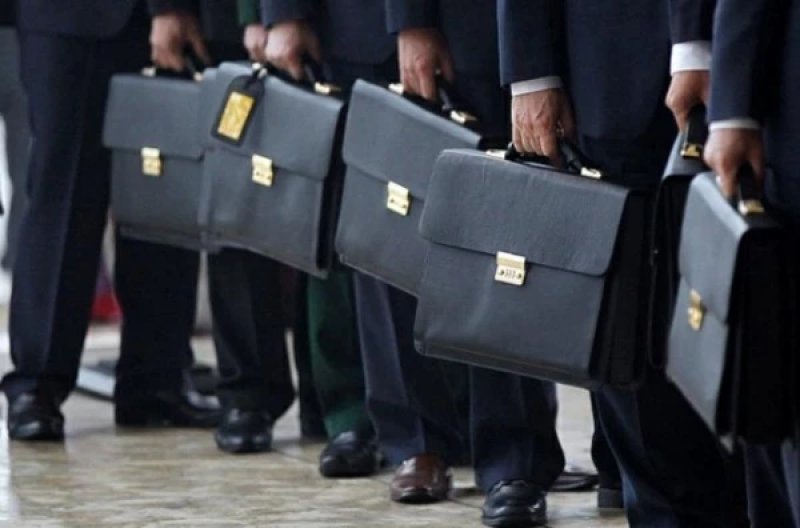
 Foto: BB.LV / люди с портфелями
He explained that there are conditionally two approaches to forming public administration in the world. One of them is the American model, where after a change in political power, a significant portion of high-ranking officials is replaced. "A new power comes in, and changes occur even at the level of department heads. Everyone understands and accepts this. New politicians come in, and a large part of the bureaucracy changes as well," said Endziņš. As an example, he also mentioned U.S. ambassadors, among whom there are both professional diplomats and politically appointed individuals. The second approach, according to Endziņš, is the German model. In this model, the political leadership changes, but the professional bureaucracy remains and ensures the continuity of public administration. This model was once attempted to be adopted by Latvia as well. However, in Endziņš's opinion, over time, the system in Latvia has become much less clear. "In essence, de facto, we have neither of the two," he said. The problem, in his view, begins at the moment when theoretically politically neutral bureaucracy itself acquires a political "flavor." Endziņš pointed to situations where a minister represents one political force, while a high-ranking official is actually associated with a completely different party. "The minister is from one party, the state secretary is from a completely different party. This is already a conflict by definition, and it should not be like this," he emphasized. In his opinion, in the case of Latvia, the model of professional bureaucracy should be adhered to, but a necessary condition for this is the political neutrality of officials. "It is very important for the bureaucracy to truly be independent and loyal to the political leadership that is at the top," said Endziņš. He believes that otherwise, a situation may arise where the political leadership of the ministry and the administrative apparatus have opposing interests. "If a person is connected to another party that is in conflict and in opposition, what kind of cooperation can there be? There can’t be any. There is an embedded conflict of interest, and then real sabotage begins," stated Endziņš. In his opinion, this issue should not be reduced solely to the personal qualities of specific politicians or officials. The main problem lies in the structure of the system itself and whether the spheres of political and administrative governance are clearly delineated in Latvia.
