

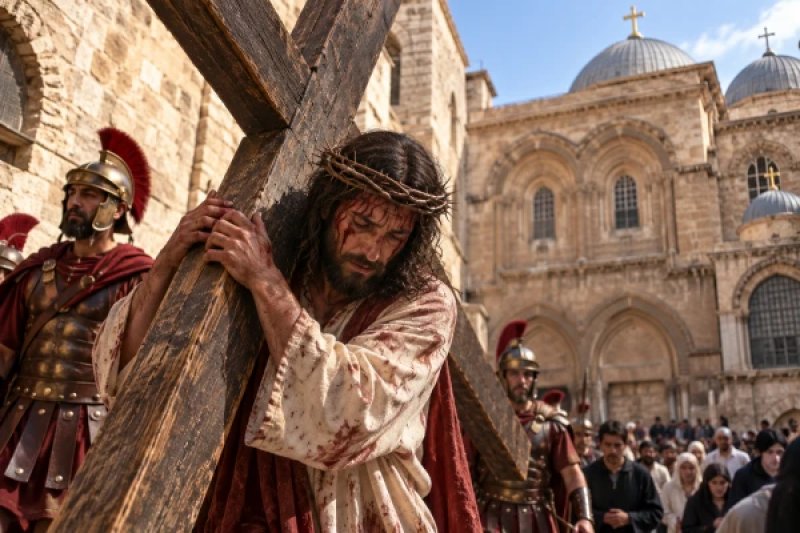
 Foto: BB.LV / Несение креста
Under the church built in the 4th century, they discovered a quarry, traces of cultivated plots and a garden, as well as a tomb hewn into the rock. According to the head of the work, Francesca Romana Stasolla, these are the very fields that, according to the New Testament, were located between the walls of Jerusalem and Golgotha. The garden found is of particular significance, as the Gospel of John mentions a garden at the site of Jesus' crucifixion. The traces of olive trees and vines are dated (albeit imprecisely) to around the time typically associated with Jesus' death. The Gospels of Matthew, Mark, and Luke describe Jesus' tomb as a sepulcher hewn into the rock. The discovery of a round stone structure fits into this picture and allows for the suggestion that the temple, which became one of the main shrines for Christians, arose precisely around this tomb. The archaeological finds do not provide scientifically irrefutable evidence that Jesus was buried here. However, the results of the work show that this site, venerated by Christians for nearly two thousand years, possesses characteristics that somewhat align with the descriptions in the New Testament. The Church of the Holy Sepulchre, which Orthodox Christians also call the Church of the Resurrection, is located in the Christian quarter of the Old City of Jerusalem. The first church on this site was consecrated in 335 AD. Over the subsequent centuries, the building was repeatedly destroyed and rebuilt. Therefore, the modern appearance of the temple is the result of numerous stages of construction and restoration. For a long time, any renovations, repair work, or archaeological excavations were hardly conducted, as the temple is jointly owned by representatives of several Christian denominations, each fearing for its rights and influence. Now the parties have managed to reach an agreement. Since 2016, the Church of the Holy Sepulchre has been undergoing restoration — the first time in more than two centuries.
