

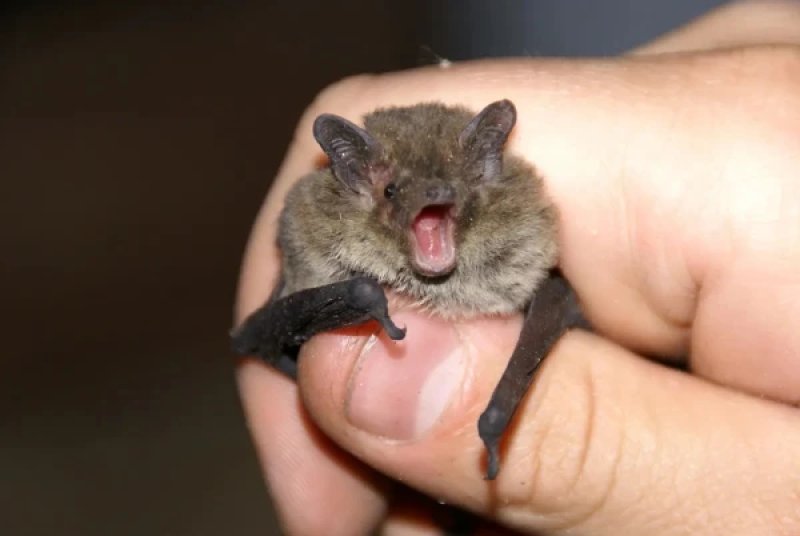
 Foto: BB.LV / Лесной нетопырь
It is hard to imagine that an animal weighing less than two American nickels can cover a distance comparable to traveling through several European countries. However, this is exactly the kind of migration that forest bats (Pipistrellus nathusii) — small brown bats, whose weight usually does not exceed 10 grams — undertake, writes [IFLScience](https://www.iflscience.com/teeny-tiny-bat-the-weight-of-two-us-nickels-can-fly-over-2000-kilometers-in-record-breaking-migration-85033). Despite their miniature size, these animals are capable of flying vast distances in search of suitable habitats and breeding grounds. It is representatives of this species that set two impressive migration records, one of which is directly related to Latvia. ### From Latvia to Spain — over 2200 kilometers In August 2015, researchers tagged a forest bat in Latvia. The special marker allowed the animal to be identified if it was subsequently found elsewhere. Two years later, the same bat was found dead in Navarre, Spain. The straight-line distance between the two points was 2224 kilometers. The research results were [published](https://www.degruyterbrill.com/document/doi/10.1515/mammalia-2020-0069/html) in a scientific article in 2020. However, scientists believe that the actual route could have been significantly longer. The fact is that during seasonal migrations, forest bats often follow the coastline of the Baltic Sea rather than flying in a straight line. Therefore, the distance between the ringing location and the location where the animal was found only shows the minimum length of the journey. For such a small mammal, even this figure turned out to be extraordinarily high. Most European bats migrate distances of no more than a few hundred kilometers. Flights over 1000 kilometers are relatively rare. ### New Record: From Russia to the French Alps In 2022, scientists reported an even more impressive case of migration of a forest bat. This time, the record was set by a one-year-old female that was tagged in northwestern Russia. Just 63 days later, the animal was recaptured in the French Alps. The minimum distance between the two points was 2486 kilometers — more than 260 kilometers longer than the previous record associated with Latvia. The discovery surprised even the researchers themselves. "This is a very big surprise. We thought our bats migrated to Southeast European countries and other neighboring states, not to France," said lead author of the study Dr. Denis Vasenko from the A.N. Severtsov Institute of Ecology and Evolution. At the same time, 2486 kilometers is only the straight-line distance. Scientists suggest that during the journey, the female followed along part of the coastline of the Baltic Sea and may have stopped in areas of bird ringing stations. If this hypothesis is correct, the actual length of the migration could exceed 3000 kilometers. ### Why Did Such a Flight Surprise Scientists? The forest bat weighs less than 10 grams and is comparable in size to a table tennis ball. In comparison, even some much larger tropical bats undertake migrations of up to 2000 kilometers. The new record shows that the size of an animal does not always determine the distance it can cover. However, there are even longer journeys in the animal world. For example, caribou can migrate distances of about 1200 kilometers, moving across the northern territories of Canada and Greenland. Some marine animals cover tens of thousands of kilometers during migrations. Among the shortest known seasonal movements is the migration of darkling beetles, which is only about 300 meters. But in the case of the forest bat, scientists are particularly impressed by the combination of tiny size and the enormous distance of the flight. ### Why Are Scientists Studying Bat Migrations? Despite such unusual results, the migration routes of bats are still relatively poorly understood. In Europe, such studies have often been conducted in connection with planning the construction of wind power plants, as migrating bats may be at risk of colliding with operating turbines. The more accurately scientists know the routes and durations of flights, the easier it will be to identify areas where animals need additional protection. The story of the two forest bats — from Latvia and Russia — shows that even the smallest European mammals can undertake journeys across significant parts of the continent. And since the actual routes of both bats remain unknown, it is quite possible that their records were even more impressive than the official figures suggest.
