

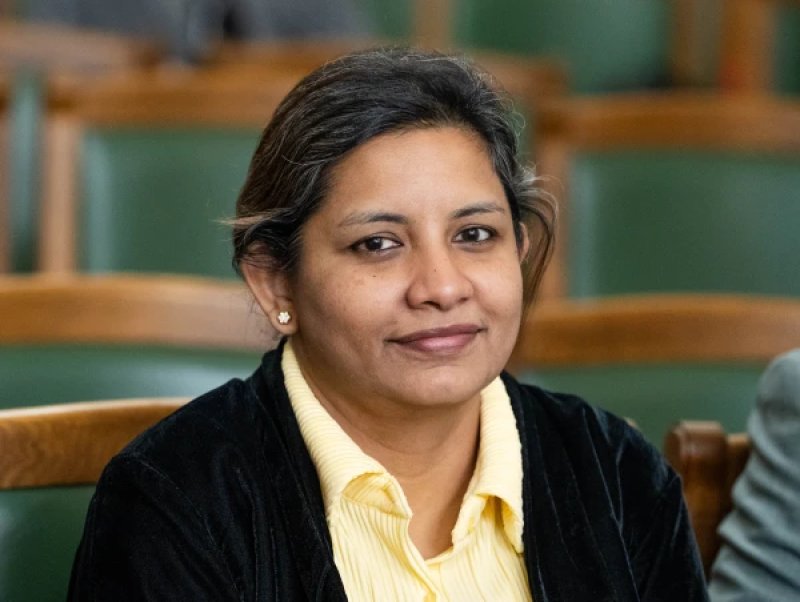
 Foto: BB.LV / Дивья Вишванат
Divya Vishwanath's investment projects, which became one of the arguments for granting her Latvian citizenship for special merits, are still predominantly at the preparatory stage. Despite announced plans to create a scientific laboratory and pharmaceutical production, a significant portion of the proposed investments has not yet been realized. This is evident from information collected by the LETA agency, which examined the status of the projects, details about the entrepreneur's education, and the circumstances surrounding the preparation of recommendations for granting her citizenship. ### The Artificial Intelligence Laboratory Has Opened, but Equipment Will Arrive Only in 2027 One of the main arguments in support of granting Vishwanath citizenship was the establishment of an artificial intelligence laboratory in Riga, at 7 Apteikas Street. The building was purchased in 2024 and then renovated. The official opening of the laboratory took place on June 12, 2026. However, according to Vishwanath herself, specialized laboratory equipment is planned to be delivered only in April 2027, with full operations starting in July. Until then, research projects were carried out using the infrastructure of a partner organization in China. One area of research is related to the application of artificial intelligence to find new ways to use already known substances in the treatment of oncological diseases. Vishwanath explained that her goal is to create a research infrastructure in Latvia that meets European requirements, rather than simply relocating an existing laboratory from China. ### The Pharmaceutical Plant in Salaspils Exists Only on Paper The second project involves transforming the Salaspils Institute of Inorganic Chemistry complex into pharmaceutical production. Vishwanath intends to create five production lines and about 110 jobs there. However, industrial production of medicines at the site is not yet underway. The project is in the stage of preparation and planning of investments. According to the entrepreneur, its cost is about 60 million euros, and implementation may take 24 months. However, at a closed meeting of the Saeima commission on October 14, she mentioned a different amount — about 70 million euros. Vishwanath reported that about 4 million euros have already been spent on acquiring real estate, renovating facilities, and preparatory work. According to Nina Linde, director of the Institute of Economics of the Latvian Academy of Sciences, about 1.5 million euros have been invested in the acquisition and renovation of real estate for the Riga laboratory. Another approximately three million is expected to be allocated for specialized equipment. Vishwanath hopes to attract the remaining investments from private capital and venture funds associated with her family business structure in Hong Kong. However, the entrepreneur did not provide financing agreements or other supporting documents, citing confidentiality. As proof of the family's financial capabilities, she cited data from the international pharmaceutical group Zoar, which is led by her husband, Kanan Vishwanath. According to the provided information, the group's turnover for the financial year ending March 31, 2025, was about 556.4 million US dollars. ### The Latvian Academy of Sciences Assessed Prospects but Did Not Verify the Availability of Funds Recommendations for granting Vishwanath citizenship were given by the president of the Latvian Academy of Sciences (LAS), Ivars Kalvins, and the academy's secretary-general, Baiba Rivža. At the same time, Nina Linde, director of the LAS Institute of Economics, explained that the institute assessed the potential economic significance of the investment projects, professional cooperation, and the entrepreneur's international contacts. An independent verification of the source of the investors' funds or their solvency was not conducted. Institute representatives visited both sites and reviewed the business plans, but the assessment primarily concerned the prospects for project implementation. Since January 2026, Vishwanath has also been working at the institute as a leading invited researcher under a grant cooperation agreement. Her activities are mainly related to organizing the International Economic Forum, preparing the scientific program, and attracting foreign experts. She does not receive a salary for this work. ### Questions Also Arise Regarding the Doctorate LETA paid special attention to Vishwanath's academic qualifications. According to information from the family's press service, she obtained her bachelor's and master's degrees from the University of Mumbai, and her doctorate in computer science from Janardan Rai Nagar Rajasthan Vidyapeeth University in India. Journalists verified the information about the apostille of three educational documents. The Indian e-Sanad system indeed has records of their certification on October 21, 2026. However, the presence of an apostille does not itself replace an independent verification of academic qualifications. In the national Indian electronic archive of doctoral dissertations, Shodhganga, LETA was unable to find a work with the title specified by the family's press service. Vishwanath emphasized that the absence of the dissertation in the open archive does not mean that it did not exist or that the degree was awarded illegally. According to her, she has requested official confirmation of the awarding of her doctorate and information about the defense of her dissertation from the university. At the same time, the entrepreneur did not provide journalists with the dissertation itself, the abstract, bibliography, or defense documents, citing confidentiality and privacy concerns. Attempts by LETA to independently obtain confirmation from the universities by the time of publication were unsuccessful. ### The Latvian Center for Academic Information Did Not Verify the Documents Either The Academic Information Center (AIC) confirmed that Vishwanath's educational documents had not been submitted to it for examination. The center explained that it can verify the issuance of foreign diplomas, the awarding of qualifications, and the status of educational institutions. However, the assessment of the scientific quality of the dissertation, its originality, or possible plagiarism is not within the AIC's competence. Vishwanath herself explained the lack of expertise by stating that she did not apply for positions that require recognition of foreign qualifications in Latvia. ### The Saeima First Granted Citizenship and Then Revoked the Decision The story gained wide public resonance after the Saeima passed a law granting Vishwanath citizenship for special merits on October 15. Just a week later, on October 22, the parliament passed a law revoking the previous decision. The reason was the questions that arose regarding the entrepreneur's education, her scientific publications, and the justification for granting citizenship. The President of Latvia urged deputies to eliminate doubts and reconsider the decision if necessary. The Presidium of the Latvian Academy of Sciences later stated that Ivars Kalvins, in recommending Vishwanath for citizenship, acted within his authority and in good faith, relying on the information presented to him. The entrepreneur herself rejects doubts about the authenticity of her documents. Meanwhile, the prosecutor's office has begun an investigation into the circumstances surrounding the granting of Latvian citizenship to her. The investigation will also touch upon the actual role of the Latvian Academy of Sciences in such cases and the circumstances surrounding the granting of citizenship to her husband, Kanan Vishwanath, who received a Latvian passport in September 2023.
