

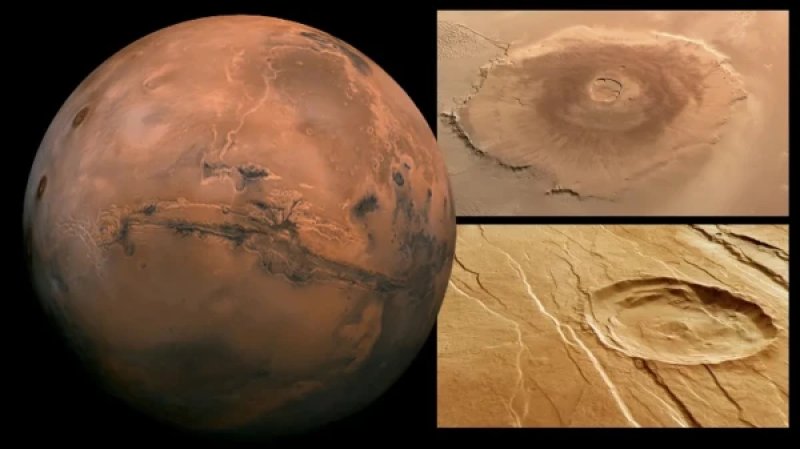
 Foto: BB.LV / Марс
If the hypothesis is confirmed, it will change our understanding not only of Mars' geology but also of the possible conditions for the existence of life, reports [Space](https://www.space.com/astronomy/mars/mars-isnt-dead-recent-volcanic-activity-reveals-its-just-sleeping). ### Mars' Volcanoes May Be Dormant, Not Extinct Mars is known for its giant volcanoes. The most famous of these is Olympus Mons, which rises about 26 kilometers above the surrounding plains. It is the tallest mountain in the solar system. For a long time, scientists believed that the era of active volcanism on the Red Planet was a thing of the distant past. However, new observations from the European orbital spacecraft ExoMars Trace Gas Orbiter (TGO) are prompting a reevaluation of this viewpoint. Researchers have detected unusual concentrations of hydrogen chloride in the atmosphere above volcanic fissures in the Alba Mons region. This volcano is located in the Tharsis region, which also hosts Olympus Mons. Although Alba is significantly lower than its famous neighbor, it surpasses other volcanoes in the solar system in area: its diameter reaches about 600 kilometers. On Earth, hydrogen chloride can be released from volcanic vents along with gases from hot magma. Therefore, its presence above Martian volcanic fissures may indicate that the depths of the Red Planet still retain heat and geological activity. ### Gas Appears Where It Shouldn’t Be The significance of the discovery lies not only in the detection of hydrogen chloride itself but also in the timing of its appearance. Typically, the concentration of this gas in the Martian atmosphere increases during winter in the northern hemisphere and decreases in summer. Such seasonal changes are related to the water and dust cycles. However, in the Alba Mons region, researchers observed the opposite pattern. At the beginning of Martian summer, there were sharp increases in hydrogen chloride concentrations above the volcanic fissures. Scientists hypothesized that the gas might be coming from the planet's depths but gets trapped under a layer of ice during winter. When the ice sublimates in summer—transitioning directly from solid to gaseous state—the accumulated hydrogen chloride is released into the atmosphere. This may explain the unusual seasonal spikes recorded by TGO. ### “It Was Like Searching for a Needle in a Haystack” One of the leaders of the study, Daniel Mej, a researcher at the Space Research Center of the Polish Academy of Sciences, called the detection of the gas important evidence of possible volcanic activity. > “Our results indicate that Mars has retained enough internal heat to sustain volcanic activity up until recently, and it may still be ongoing,” the scientist told Space.com. According to him, detecting such a weak signal proved to be extremely challenging. > “TGO managed to find crucial evidence. It was like searching for a needle in a haystack,” Mej noted. The spacecraft had to capture a small number of gas molecules that likely enter the atmosphere only periodically. At the same time, researchers had to carefully consider other possible explanations—primarily chemical processes in the Martian atmosphere. Mej acknowledged that the initial distribution of gas emissions immediately reminded him of volcanic activity, but this hypothesis still needed to be substantiated. ### Signs of Recent Activity Have Already Been Found on Mars The new study complements other evidence that Mars has not completely lost its geological activity. Previous orbital images indicated that some volcanoes might have erupted within the last few million years. Additionally, seismometers have recorded marsquakes—underground tremors that indicate processes occurring in the planet's interior. Now, unusual hydrogen chloride emissions and observations of fissures in the Alba Mons region have been added to this data. Researchers speculate that there may be a system of channels and reservoirs beneath the surface connected to a dormant magma chamber. However, there are currently no direct observations of recent eruptions or lava flows on Mars. Therefore, the presence of active magma remains a scientific hypothesis that needs to be tested. ### The Discovery May Suggest Where to Look for Life on Mars Possible volcanic activity is significant not only for studying the geology of the Red Planet. If sources of heat still exist beneath its surface, they could create conditions favorable for microorganisms. On Earth, such environments are found in hydrothermal systems where hot rocks interact with water. Scientists suggest that in the past, volcanic activity on Mars may have contributed to the formation of a denser atmosphere and a warmer climate. Gases released from the depths could have influenced atmospheric conditions, and the interaction of magma with groundwater could have created localized areas suitable for life. If such systems have persisted to the present day, they may be of particular interest for future missions. > “Searching for Martian life in the fissures where gases seep in the Alba Mons region would make a lot of sense,” Mej believes. According to him, active hydrothermal systems could potentially provide microorganisms with essential nutrients and energy while simultaneously protecting them from the harsh conditions on the Martian surface. The detection of hydrogen chloride alone does not prove the existence of life. However, it gives scientists another clue about where to look for it.
