

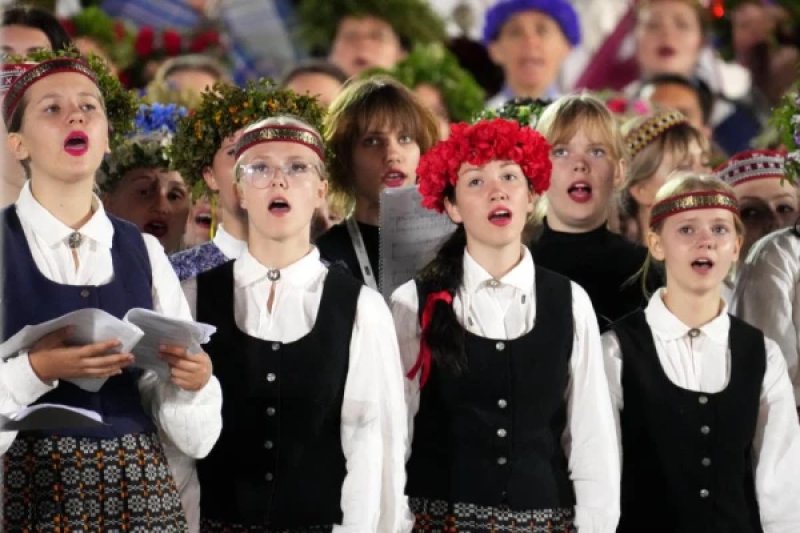
 Foto: BB.LV / Праздник песни
According to Berzinia, the foundation of a cohesive society could be the values enshrined in the core of the Constitution: state sovereignty and territorial integrity, democracy, republican governance, popular sovereignty that provides for civil and political participation, as well as the principles of a legal, socially responsible, and national state. The researcher believes that long-standing differences in attitudes towards the state depending on the language spoken at home can be overcome. One of the reasons for the problem she identified is the influence of Russia - both through the availability of media content that aligns with the ideological framework of its regime and through the "compatriots' policy." Without such external influence, the formation of a cohesive society in Latvia would progress more successfully. An additional obstacle, Berzinia considers, is the global information and communication technologies, whose algorithms contribute to the polarization of society. In this regard, Latvia is no exception. One of the solutions the researcher mentioned is the development of political literacy. She believes that media literacy, which is often discussed in the context of countering Russian disinformation, cannot be effective without a deeper understanding of political processes. Among the positive trends, Berzinia noted survey data indicating that approximately 60% of residents are willing to participate in strengthening the state through non-military means, while about 30% are willing to do so through military means. Among those ready for civic participation are Russian-speaking residents. The researcher sees this as significant potential and suggests developing a system of non-military participation, including drawing on the experience of supporters of Zemessardze. During the discussion "FOI on the Way to 'Latvia - 2050': Developing the Ecosystem of Social Cohesion by Connecting People, Sectors, and Opportunities," the Chair of the Council for Public Electronic Media, Sanita Upleja-Egermane, noted that among young people born after the restoration of Latvia's independence and educated here, but speaking Russian at home, there are those whose views still need to be changed through persuasion. However, she expressed doubt that this would be successful. According to Upleja-Egermane, these young people find themselves in a complex value situation: Russia is waging a war, claiming to act on behalf of the Russian people, while in Latvia, Russian aggression is sharply condemned. Speaking about changes in the media environment and the influence of social networks, Upleja-Egermane predicted a further complication of the situation. At the same time, she believes that the role of traditional and public media will increase in strengthening the values of the Constitution, democracy, and freedom of speech. The Deputy Director of the State Chancellery for State Development Issues, Head of the Interagency Coordination Department, Peteris Vilks, pointed out the extremely high level of income inequality, which is related to the indicators of social cohesion. As reported, on Thursday, the FOI presented the results of the study "Social Cohesion Radar - 2026." According to the survey, 61% of residents feel accepted in Latvia - seven percentage points less than in 2023. Presenting the study results, researcher from the public policy center "Providus," Iveta Kazoka, emphasized that the sense of acceptance plays an important role in social cohesion. People who feel accepted in Latvia are more likely to feel a connection to the state, trust their fellow citizens, see common values with them, and rate equality of opportunity higher. However, these statistical correlations do not allow establishing a causal relationship. Kazoka paid special attention to the youth. Residents aged 18-30 are more likely than those aged 50-75 to believe that their voice matters in Latvia and see equal opportunities for life advancement. Young people who speak Russian at home also note cultural, educational, and economic opportunities in the country. At the same time, the researcher expressed concern that the sense of acceptance in Latvia is equally low among both young and older residents who speak Russian at home.
