

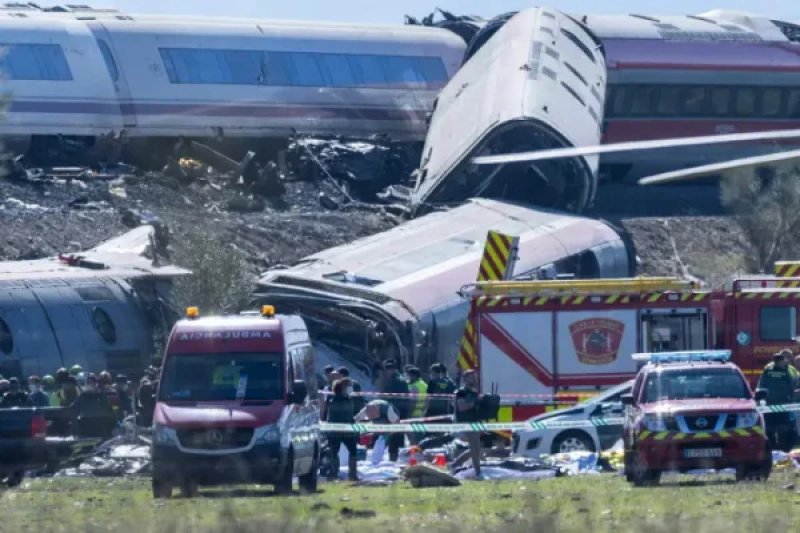
 Foto: BB.LV / Вблизи станции Урда столкнулись поезда AVE и Iryo.
Investigators intend to find out how European funds, intended in part for improving traffic safety, were spent. On November 6, the European Public Prosecutor's Office (EPPO) announced a new investigation into alleged fraud involving the financing of the modernization of Spain's railway infrastructure, [reports](https://entrevue.fr/ru/europe/espagne-apres-la-catastrophe-ferroviaire-durda-des-soupcons-de-fraude/) Entrevue. The increased attention was prompted by the disaster that occurred on October 28 near the town of Urda in the province of Toledo. At that time, a high-speed train operated by the state company Renfe collided with a stationary train from the private carrier Iryo. Sixty-nine people died. According to an [official statement from the European Public Prosecutor's Office](https://www.eppo.europa.eu/media/news/spain-eppo-launches-second-investigation-possible-fraud-involving-eu-funds-maintenance-madrid-2026-11-06_en), the investigation concerns EU funds allocated for upgrading safety, signaling, and communication systems on the high-speed line from Madrid to Seville. ## Investigators have come for documents On November 6, officers from the Central Operational Unit of the Civil Guard of Spain began collecting documents from several government agencies. The checks involved the company ADIF, which manages the country's railway infrastructure, the State Agency for Railway Safety, and the Court of Auditors of Spain. The investigation was initiated by the European Public Prosecutor's Office on its own initiative. Investigators will need to determine whether the funds allocated by the EU were indeed directed to the intended projects, whether the rules for contract awarding were followed, and whether the completed work matched the declared expenses. So far, the prosecutor's office has not disclosed details of any possible violations and has not reported any charges being filed. ## Two disasters on one line The investigation is particularly acute given that the October tragedy was already the second major railway disaster on the Madrid-Seville line in 2026. On January 18, an accident near Adamuz in Andalusia resulted in the deaths of 46 people. After that, in March, the European Public Prosecutor's Office had already begun an investigation into possible violations regarding the use of European funding allocated for the maintenance of railway infrastructure. Nine months later, a new tragedy occurred — this time near Urda. Thus, two disasters on one railway line claimed a total of 115 lives. The recurrence of such severe incidents has intensified questions about the condition of the tracks, the functioning of safety systems, and the effectiveness of oversight of railway infrastructure. ## Where did 111 million euros go? In June 2024, the European Commission allocated approximately 111.6 million euros for the modernization of the high-speed line from Madrid to Seville. This line, opened in 1992, became Spain's first high-speed railway. European investments were intended for upgrading infrastructure, enhancing traffic reliability, and improving equipment that ensures train safety. Now investigators are checking how legally and effectively this funding was used. It is important to emphasize that the start of the investigation does not yet mean that fraud actually took place. Moreover, there is currently no evidence that the alleged financial violations caused the railway disasters. ## Why did the trains collide? The reasons for the accident near Urda are being established as part of a separate investigation by Spanish authorities. Preliminary data suggest that a failure occurred in the automatic safety system before the collision. Trains on one section of the line were stopped. However, the dispatch center then allowed the Renfe train to continue moving, despite the fact that a stationary Iryo train remained ahead. As a result, a collision occurred, leading to numerous casualties. The investigation will need to determine what role technical malfunctions, personnel actions, and the organization of the railway system played. ## The main question remains open Spanish authorities are now faced with two serious problems: it is necessary to establish the causes of the disasters and to determine how diligently the funds intended for improving railway safety were spent. The financial investigation and the determination of the causes of the accidents remain separate processes for now. But two tragedies on one railway line in such a short time inevitably raise the question: was enough funding invested in safety, and how effectively was its use monitored? Investigators, auditors, and judicial authorities will have to answer this question. For passengers, the main outcome of these checks should not only be the identification of those responsible but also the prevention of new disasters.
