

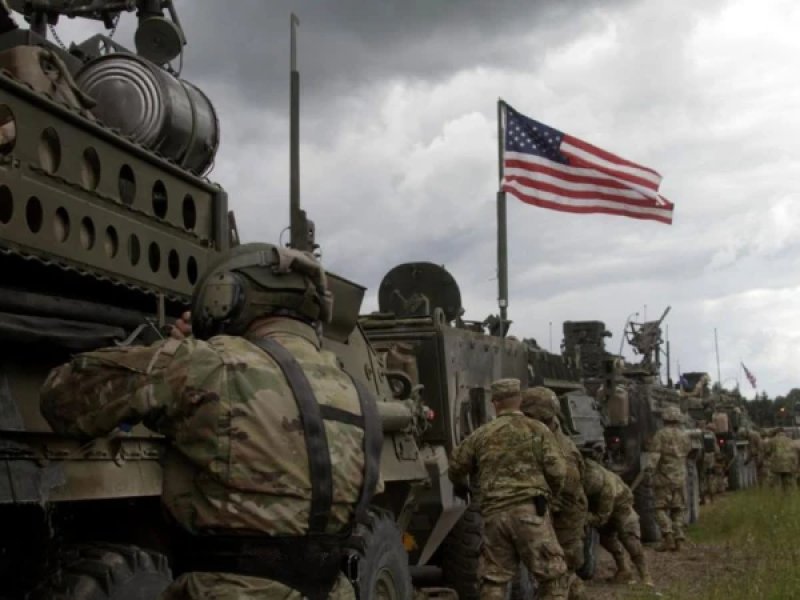
 Foto: BB.LV / армия США
US Air Force General and Supreme Allied Commander of NATO's Joint Forces in Europe Alexus Grinkevich explained at the Warsaw Security Forum that the alliance has a specific military plan. "My theory of victory is simple," the general said. According to him, NATO will first block the initial attack, then prevent further enemy advancement, and if necessary, destroy enemy forces and the warfighting system. NATO's military capabilities still largely depend on the US, especially in areas such as air power, long-range strikes, and other high-intensity warfare capabilities. This is why Washington's political position is so important for countries on NATO's eastern flank. ## ## A Clear 'No' Followed the Direct Question A particularly telling moment at the Warsaw Forum occurred when Grinkevich was directly asked whether US combat units would definitely fight alongside European NATO forces in the event of a Russian invasion. "Ultimately, it’s a political decision about who and where to place troops," the general replied. At the same time, he emphasized that US forces are currently stationed throughout NATO's eastern flank. This nuance is important for the Baltic states. NATO's Article 5 provides for collective defense; however, the specific military contribution and which forces are sent to a particular country also depend on the political decisions of allies. US Ambassador to NATO Matthew Whitaker, meanwhile, attempted to allay concerns this week at the Berlin Security Conference. He indicated that US foreign policy has not changed following the midterm elections in Congress and that Washington remains committed to upholding the entire NATO treaty, including Article 5 on collective defense. ## ## Movement of US Troops in the Baltics Has Already Raised Concerns Reuters notes that shortly before the NATO summit in Ankara, the US quietly withdrew several combat units from the most vulnerable Baltic states. This raised concerns within the alliance. More reassuring signals followed — it was announced that two American military units would spend the winter in Lithuania, and an American tank unit would return to eastern Estonia. At the same time, Reuters emphasizes that there is currently no intelligence indicating an imminent conventional attack by Russia on NATO. Nevertheless, European officials are speaking of an increasingly intense hybrid threat — cyberattacks, sabotage, and the incursion of drones or other aircraft into the airspace of NATO's eastern flank. Latvia also reported this week about two drones that entered its airspace; one of them, according to initial assessments by Latvian military, could be a Russian-type "Geran" drone. ## ## "We Know What We Need to Do" Grinkevich acknowledges that the alliance's residents are concerned about the current security situation, but emphasizes that NATO knows how to act. "I want to assure one billion residents of our alliance that we will handle this. We know what we need to do. We all will have to work together, but we will manage it," the NATO commander said. At the same time, Reuters analysis shows that the security of the Baltics is influenced not only by military plans but also by politics in Washington, Paris, and Berlin. European countries are increasingly investing in their own defense capabilities to reduce dependence on the US; however, until the end of the decade, several important NATO capabilities will still largely depend on American support.
