

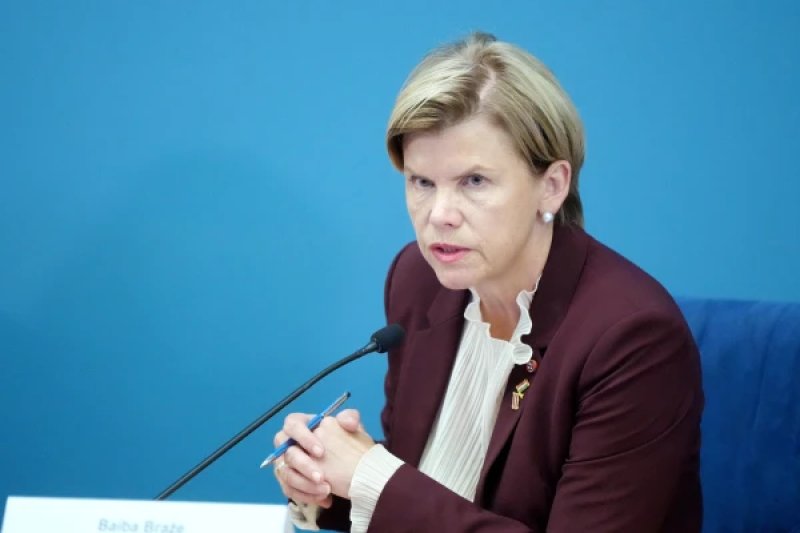
 Foto: BB.LV / Байба Браже
This was stated by Latvia's Foreign Minister Baiba Braže at a meeting of the foreign ministers of the Baltic Sea countries and Ukraine in Warsaw. According to the Ministry of Foreign Affairs of Latvia, the meeting took place on Friday, November 6. The participants discussed the security situation in the region, the threats of hybrid warfare from Russia, and the migration pressure from Belarus. Particular attention was paid to further support for Ukraine, including preparing the country for the upcoming winter. ## "Provocations and Diversions Can Affect Any Ally" According to Braže, Russia's actions pose a threat not only to individual states but to the entire European security system. The minister emphasized that Russian provocations and diversions could affect any of the allies. Therefore, she believes that European countries need to not only strengthen their own resilience but also maintain economic pressure on Moscow, continue its international isolation, and tighten sanctions. Braže also called for preventing Russian athletes and cultural figures from participating in international events. In addition, the head of the Latvian Foreign Ministry advocated for a ban on entry into the European Union for former Russian military personnel and restrictions on the ability of Russian citizens to benefit from tourist travel to the EU. ## Almost 13,000 Attempts at Illegal Border Crossing A separate topic of discussion was the increasing migration pressure on the eastern border of the European Union and NATO. Braže reported that Latvia has already prevented almost 13,000 cases of illegal border crossing from Belarus within 2026. According to the minister, the migration pressure organized by the Belarusian authorities is part of a broader campaign against European security. "The pressure exerted by Belarus through illegal migration on the eastern border of the EU and NATO is part of a larger assault by Russia on the security of Europe," Braže stated. ## Ukraine Promised Assistance Before Winter The participants of the meeting confirmed their readiness to continue comprehensive military, humanitarian, and financial support for Ukraine. Particular attention was paid to strengthening the resilience of Ukraine's energy infrastructure and enhancing air defense. These issues take on special significance against the backdrop of increased Russian attacks on the population, critical, and civilian infrastructure of Ukraine. The ministers also discussed Ukraine's financial situation and the need to secure funds for its state budget and defense needs in 2027. The participants agreed that it is necessary to find an appropriate financial solution for this. ## Europe Intends to Participate in Peace Negotiations The meeting also discussed the role of European states in negotiations to achieve peace in Ukraine. As a result of the negotiations, a joint declaration was signed, providing for further support for Ukraine, promoting the establishment of a just and lasting peace, increasing sanctions against Russia, and strengthening European security. Baiba Braže emphasized that continuing assistance to Ukraine combined with increased pressure on Russia remains, in her opinion, the most effective way to achieve peace. ## Who Participated in the Meeting The negotiations in Warsaw were attended by the foreign ministers of Poland, Estonia, Norway, Finland, Germany, and Ukraine, as well as the EU's High Representative for Foreign Affairs and Security Policy, Kaia Kallas. Iceland, Denmark, Sweden, and Lithuania were represented by authorized officials.
