

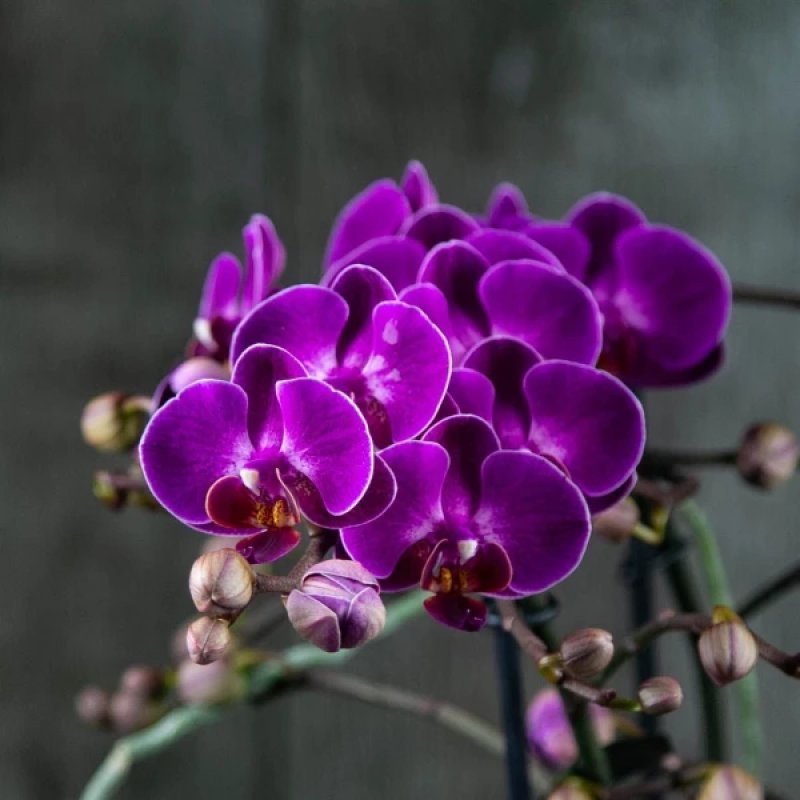
 Foto: BB.LV / Орхидея
November is a suitable time to pay special attention to house orchids. For popular Phalaenopsis, it is during this period that the formation of flower spikes often begins. However, proper watering alone is not enough. For buds to appear, the plant requires suitable lighting, moderate nutrition, and a slight difference between daytime and nighttime temperatures. As reported by the Polish publication *trojmiasto.pl*, it is especially important in autumn to check the conditions in which the orchid is kept and adjust care as necessary. ## What to water orchids with to make them bloom The main rule is to use soft water at room temperature. Orchids are sensitive to excess mineral salts, so hard tap water can gradually deteriorate the condition of the roots. Filtered or clean rainwater is suitable for watering. Boiled and cooled water can also be used, although boiling does not eliminate all dissolved salts. Homemade remedies for stimulating flowering are often recommended online: banana peel infusion, weak tea, or water with lemon juice. However, specialists advise approaching such recipes with caution. Their effectiveness is not proven, and organic infusions can promote the development of microorganisms in the substrate. Incorrect acidity of the solution can also damage the roots. It is much more reliable to use a special fertilizer for orchids. During the active growth period, fertilization can be done about once every two to three weeks, based on the manufacturer’s instructions and the condition of the plant. If necessary, the concentration of the solution can be reduced to half or a quarter of the recommended dose. It is important to remember that an excess of fertilizers does not speed up blooming. On the contrary, the accumulation of salts in the substrate can lead to root damage. ## How to properly water orchids in autumn One convenient method is immersion watering. The pot with the orchid is placed in a container of water for about 15–30 minutes, after which excess liquid is allowed to drain completely. It is especially important to ensure that water does not stagnate at the bottom of the decorative pot. Constant moisture can cause root rot. The condition of the substrate and roots helps determine the need for watering. If the roots of the Phalaenopsis in a transparent pot are green, they are usually sufficiently moist. A silvery-gray hue often indicates that the roots have dried out. However, it is not advisable to rely solely on color. Before watering, it is necessary to ensure that the substrate has also dried out. On average, house orchids are watered once every 7–10 days, but in autumn and winter, this interval may increase. The frequency depends on air temperature, humidity, lighting, pot size, and substrate composition. For Phalaenopsis, short-term drying of the roots is usually less dangerous than constant overwatering. ## A little trick: temperature fluctuations help the formation of flower spikes One of the important factors that contribute to the blooming of Phalaenopsis is a moderate difference between daytime and nighttime temperatures. To stimulate the formation of flower spikes, nighttime temperatures around +16…+18 °C with warmer air during the day are beneficial. A difference of about 4–6 degrees can signal the plant to enter a new stage of development. At the same time, it is not necessary to take the orchid out to a cold balcony or leave it near an open window. Sudden cooling and drafts can damage the leaves and roots. It is sufficient to move the plant to a cooler room with good lighting for a while. ## Five conditions for abundant blooming To ensure that the orchid forms flower spikes and delights with buds for a long time, several rules must be followed: 1. **Provide bright, diffused light.** In autumn, when the daylight hours shorten, the plant may require additional lighting. 2. **Maintain a moderate temperature difference.** Cooler nights can stimulate the formation of flower spikes in Phalaenopsis. 3. **Water only after the substrate has dried.** Constantly moist roots significantly increase the risk of rot. 4. **Use appropriate fertilizer.** Fertilization should be moderate, especially in low light conditions. 5. **Do not disturb the plant unnecessarily.** Frequent rearrangements, drafts, and sudden changes in conditions can negatively affect bud formation. ## How long can an orchid bloom Under favorable conditions, the blooming of Phalaenopsis often lasts from two to four months. Some healthy plants can keep their flowers even longer — up to six months, although the duration depends on the variety, age, and care conditions. If the orchid is not blooming, do not immediately increase the amount of fertilizer or try dubious homemade mixtures. It is much more beneficial to check the lighting, root condition, watering regime, and room temperature. **The main secret of autumn blooming is not a magical additive in the water, but a combination of proper care, sufficient light, and moderate temperature fluctuations.**
